Manage Multiple Projects in Eres: Separate Books, Shared Resources
Learn how Eres helps businesses manage multiple projects with separate books and ledgers while securely sharing bank accounts, customers, suppliers, and other selected resources
Manage Multiple Projects in Eres: Separate Books, Shared Resources
Managing multiple projects, businesses, branches, or operational units can quickly become complicated. Each project may require its own transactions, financial reports, account balances, and bookkeeping records. At the same time, those projects may depend on the same bank accounts, customers, suppliers, employees, or system users.
Without the right system, businesses often have to choose between keeping everything together—which makes financial reporting confusing—or creating completely separate systems that duplicate data and increase administrative work.
Eres provides a more flexible approach.
With multi-project management in Eres, every project can maintain its own books and ledgers while selected resources can be securely shared across projects. This gives businesses financial separation where it matters and centralized access where it is useful.
What Is Multi-Project Management in Eres?
Multi-project management allows an organization to create and operate more than one project from a single Eres account.
A project may represent:
A separate business
A company branch
A department
A client operation
A store or location
A construction or service project
A specific financial entity
Each project functions as its own accounting workspace. Its transactions, balances, vouchers, invoices, expenses, and reports remain separate from other projects.
Users can move between authorized projects without maintaining multiple logins or duplicating their system access.
Separate Books for Every Project
Financial separation is one of the most important parts of managing multiple projects.
Each project in Eres maintains its own books and accounting records. A transaction recorded under one project does not automatically affect the balance of another project.
Separate project records can include:
Sales and purchase transactions
Income and expenses
Vouchers
Invoices and bills
Debit and credit entries
General ledger activity
Account balances
Financial reports
Opening and closing balances
Project-specific documents
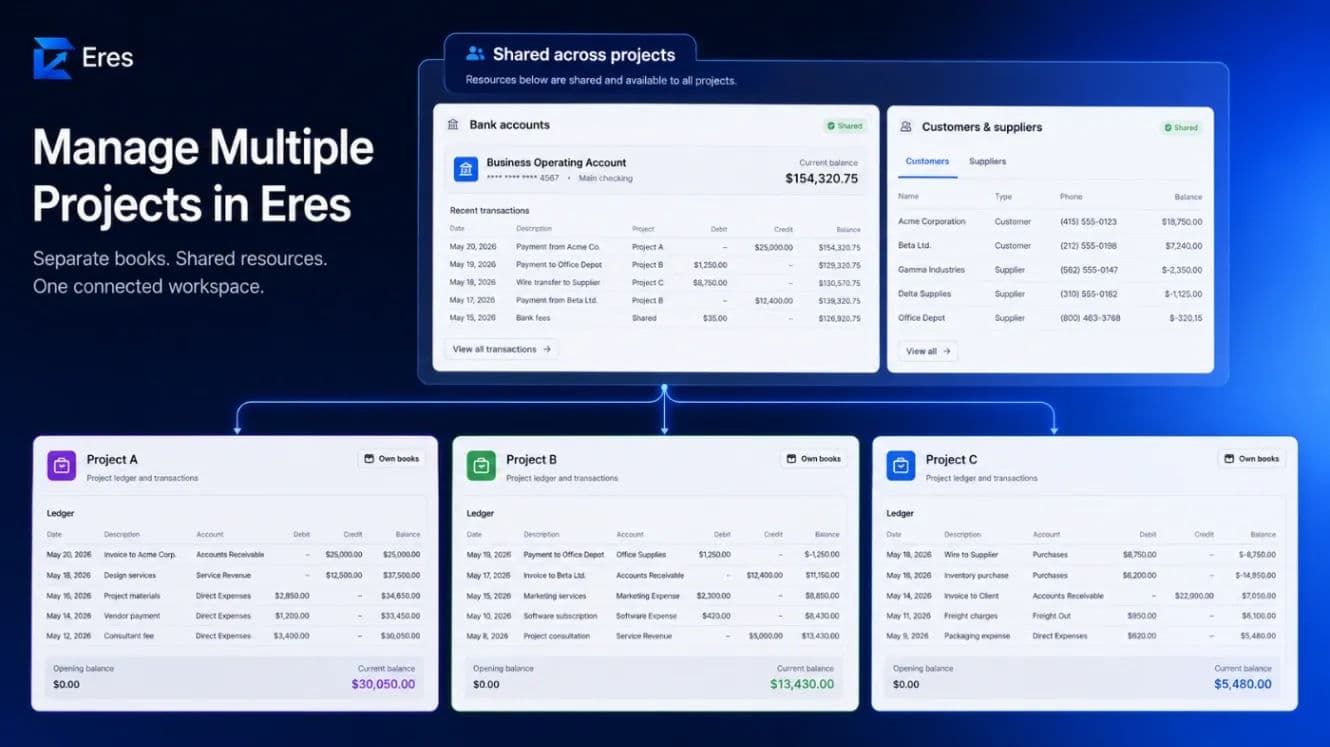
For example, if Project A records a supplier payment, that payment appears in Project A’s books. It does not change the financial balances of Project B or Project C.
This structure makes project-level accounting easier to manage, review, and audit.
Independent Ledgers and Financial Reporting
Every project can have its own ledger activity and reporting period. This allows management teams to understand how an individual project is performing without mixing its results with other operations.
Users can review information such as:
Project revenue
Operating expenses
Outstanding customer balances
Supplier liabilities
Cash movement
Profit and loss
Ledger balances
Transaction history
Separate reporting helps decision-makers identify profitable projects, control spending, monitor cash flow, and investigate financial issues more accurately.
It also provides cleaner information for accountants, auditors, project managers, and business owners.
Share Bank Accounts Across Projects
Although project books remain separate, organizations may use the same physical bank account for more than one project.
Eres can allow an authorized bank account to be shared across selected projects. This means users do not need to recreate the same bank-account record every time a new project is added.
A shared bank account can be available to multiple projects while each transaction is still assigned to the correct project.
For example:
Project A records a customer payment into the shared operating account.
Project B records a supplier payment from the same account.
Project C records a bank charge or transfer.
The bank account is shared, but the accounting effect of every transaction remains within the project where it was recorded.
Sharing access to an account does not mean combining project balances or books. It simply allows authorized projects to work with a common banking resource.
Share Customers and Suppliers
Many businesses work with the same customers and suppliers across multiple projects.
Entering the same contact separately for every project creates duplicate records, inconsistent information, and unnecessary maintenance. If a phone number, address, or contact person changes, teams may have to update it in several places.
Eres can provide a shared customer and supplier directory across selected projects.
This creates one consistent record that authorized projects can use when creating:
Sales invoices
Purchase invoices
Quotations
Orders
Receipts
Payments
Customer statements
Supplier transactions
The contact information can be shared, while invoices, balances, payments, and ledger entries remain associated with the project that created them.
This distinction prevents duplication without compromising financial separation.
Centralized User Access
Businesses should not need to create a separate user account for every project.
Eres can provide centralized system-user management while still controlling which projects each person can access.
Administrators can determine:
Which projects a user can open
What modules the user can access
Which actions the user can perform
Whether the user can create or approve transactions
Whether the user can view financial information
Whether access should be restricted to a specific role
For example, a senior accountant may have access to all projects, while a project manager may only have access to the project they supervise.
This gives users one convenient login while preserving project-level permissions and security.
Choose What Should Be Shared
Not every resource needs to be available across every project. Eres allows the organization to decide which information should remain independent and which information should be shared.
Depending on the organization’s setup, shared resources may include:
Bank and cash accounts
Customers and suppliers
System users
Document templates
Printers
Inventory records
Sites or locations
Selected chart-of-account structures
Sharing can be configured according to operational requirements. A resource may be shared with all projects, shared with selected projects, or kept entirely within one project.
This flexibility helps Eres support different business structures without forcing every organization to follow the same model.
Shared Account Structure Does Not Mean Shared Balances
It is important to distinguish between sharing an account definition and sharing its financial balance.
Projects may use the same account structure or bank-account reference, but the transactions and balances created by each project remain separate.
For instance, several projects may use an account called “Office Supplies.” Sharing this account structure helps maintain consistent financial classifications across the organization.
However, an expense posted by Project A remains part of Project A’s records. It does not become an expense for Project B simply because both projects use the same account name.
This gives organizations consistent accounting structures without combining their financial activity.
Reduce Duplicate Data
Duplicate records are a common problem in systems where each project operates in complete isolation.
The same customer may be entered several times with different spellings. Supplier details may become outdated in one project but remain correct in another. Users may have multiple accounts, making access harder to control.
Eres reduces this duplication by allowing reusable information to be maintained centrally.
The result is:
Cleaner business data
Fewer duplicate records
More consistent contact information
Faster project setup
Easier user administration
Reduced manual work
Fewer data-entry mistakes
Teams can spend less time maintaining repeated records and more time managing their operations.
Improve Financial Visibility
Separate books make it easier to evaluate individual projects, while centralized access gives management a broader view of the organization.
Authorized users can move between projects to review financial activity without signing in to separate systems.
This helps businesses:
Compare project performance
Monitor spending
Review outstanding balances
Identify cash-flow requirements
Maintain stronger financial controls
Prepare more accurate project reports
Make informed operational decisions
The organization gains visibility across its operations without losing the detailed financial separation required for project-level accounting.
Support Business Growth
A system designed for only one business or project can become difficult to manage as the organization grows.
New branches, clients, departments, or legal entities may require new accounting environments. Creating disconnected systems for each one increases costs and makes reporting more complicated.
Eres provides a scalable structure in which additional projects can be created within the same organization.
Each new project can receive:
Its own books and ledgers
Its own transactions and reports
Its own access permissions
Its own operational configuration
Access to approved shared resources
This makes it easier to expand without rebuilding the organization’s entire accounting process.
Maintain Control and Data Security
Sharing resources must not remove accountability.
Eres combines shared access with project-level controls so that users only see and manage the information relevant to their responsibilities.
Permissions and project assignments help organizations maintain:
Controlled financial access
Clear user responsibilities
Consistent approval processes
Reliable transaction ownership
Better accountability
More secure business information
Every transaction remains connected to the project that created it, providing a clear record for reporting and review.
A More Connected Way to Manage Projects
Multi-project management should not require businesses to choose between complete isolation and completely combined data.
Eres provides a balanced approach:
Separate books for accurate project accounting
Independent ledgers and balances
Shared bank accounts where appropriate
Reusable customer and supplier information
Centralized user access
Configurable sharing controls
One connected workspace
Projects remain financially independent while still benefiting from the shared resources used across the organization.
Manage Multiple Projects with Confidence
Whether an organization manages multiple businesses, client projects, branches, stores, or operational teams, Eres provides the structure needed to keep financial information organized.
Every project can maintain its own records, balances, and reports. At the same time, selected resources can be shared to reduce duplication and simplify everyday operations.
With separate books, controlled sharing, and centralized access, Eres makes multi-project accounting clearer, more efficient, and easier to scale.
Run your books on ERES
Accounting, inventory, POS, manufacturing, payroll and tax in one system — and an MCP server so your AI agent can use it too.