Lot Traceability and Recalls: A Practical Guide for Food, Feed and Pharma Producers
Lot traceability means being able to answer two questions in minutes: which raw-material lots went into this finished batch, and which customers received it. This guide covers backward and forward tracing, FEFO, what a recall report must contain and how to run a mock recall drill.
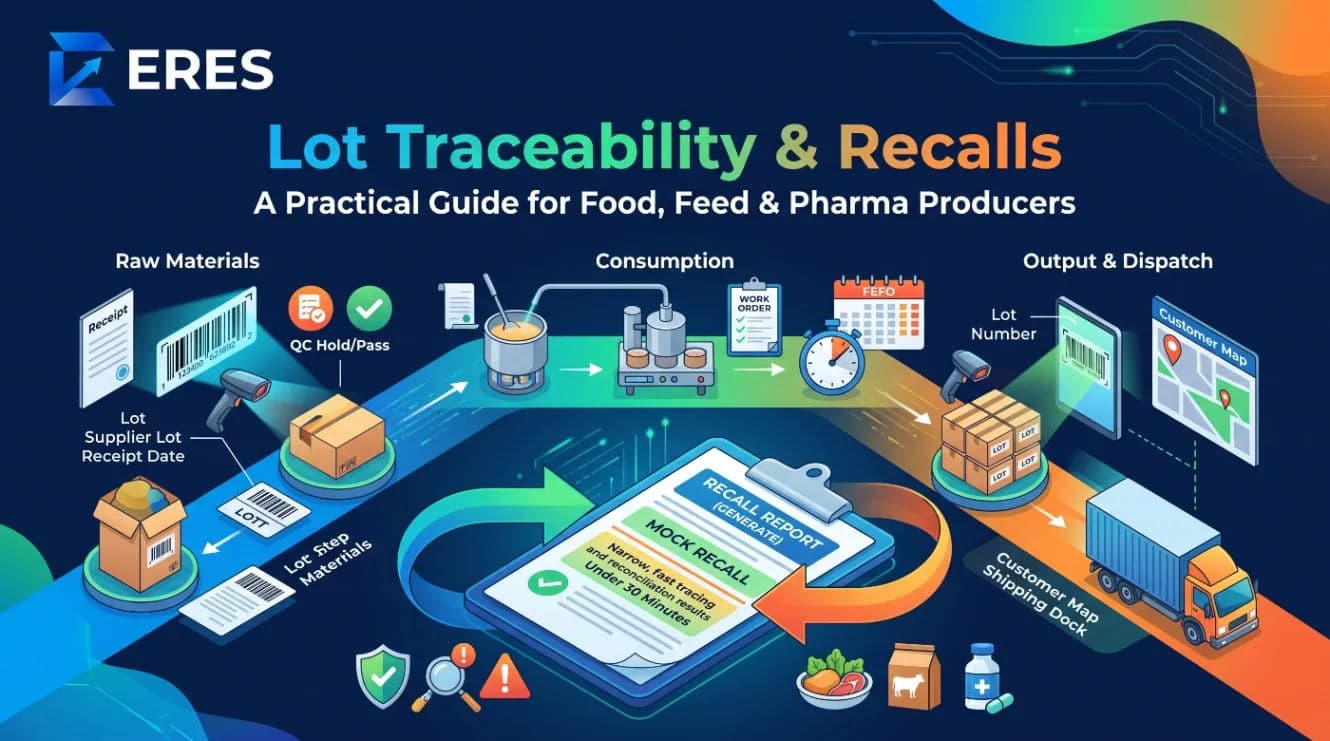
Lot traceability is the ability to follow a material one step back and one step forward at every point in production: which supplier deliveries went into a batch, and which customers received the finished lot. If you can answer both questions for any lot within a few minutes, you can run a recall that is narrow, fast and defensible. If you cannot, every recall becomes a full product withdrawal.
This guide is for producers of food, animal feed, nutraceuticals and pharmaceuticals, where lot identity is a regulatory expectation and a commercial necessity. It covers how tracing works, how first-expiry-first-out issue keeps the chain clean, what a recall report has to contain, and how to rehearse before it is real.
The three links in the chain
- Receipt. Every delivery of a raw material or packaging item lands in its own lot, with the supplier, the supplier's lot number, the quantity, the cost and the expiry or best-before date.
- Consumption. When a batch is made, the work order records exactly which lots were issued at which stage, in what quantity — not just the item.
- Output and dispatch. The finished product is received into a new lot with its own number, and every sale, transfer or sample records the finished lot it was taken from.
Break any link and the chain is worthless. The most common break is the second one: material is issued "by item" because the operator picked whatever bag was nearest, and the system records a quantity against an item instead of a lot.
Backward trace: finished lot to suppliers
Start from a finished lot number — the one printed on the bag, bottle or carton. The trace lists each raw-material lot consumed, the supplier, the supplier's lot reference, the receipt date and the expiry. For multi-stage products it goes through intermediates: a premix lot used in a feed batch is itself traced to its vitamins and minerals.
Backward tracing answers the customer complaint. "This batch tastes off" becomes "these three deliveries of fragrance, flour or fishmeal are the candidates".
Forward trace: supplier lot to customers
Start from a raw-material lot — usually because the supplier has notified a problem. The trace lists every batch that consumed it, every finished lot produced from those batches, and every customer, order and delivery that received those finished lots, with quantities. It should also show what is still in your own stock and can simply be quarantined.
Forward tracing is what makes a recall narrow. Without it, a supplier alert on one delivery of an ingredient means withdrawing everything made in the window — weeks of production.
FEFO: why expiry-first issue matters for traceability
First-expiry-first-out issues the lot with the earliest expiry date first, rather than the oldest receipt (FIFO). For perishable inputs it reduces waste, but it also has a traceability benefit: when the system chooses the lot, the lot is recorded automatically and consistently. The operator confirms rather than decides, and the record matches the floor.
Two rules make FEFO work in practice:
- Expired lots are blocked from issue by default, with a controlled override that is logged.
- A lot on QC hold is not available to FEFO at all, so a failed inspection cannot leak into a batch by accident.
Lot numbering that helps rather than hinders
A lot number only has to be unique and permanent, but a little structure makes life easier on the floor and in the trace. Two conventions work well:
- Receipts: a sequence per site with the receipt date embedded, for example
RM-2026-10-0142, with the supplier's own lot number stored alongside rather than encoded. - Finished lots: the work order number plus the output date, for example
WO-26-0142-A, so anyone holding a bag can find the batch without a lookup.
Avoid numbers that encode the recipe version, the operator or the shift — those change, and a number that stops being true is worse than a plain sequence. Let the system generate lot numbers automatically; hand-written lots are the most common source of duplicates found during a mock recall.
For items with potency or assay — active ingredients, vitamins, enzymes — record the measured value against the lot at receipt. A trace that shows the assay of the exact lot used answers the second question a regulator asks after "which lot": "and what was in it?"
What a recall report must contain
When the regulator or a major customer calls, the document you produce should answer every question in one place. At minimum:
| Section | Contents |
|---|---|
| Trigger | The lot or lots under investigation, the reason, who raised it and when |
| Affected batches | Work order numbers, dates, recipe and version, quantities produced |
| Affected finished lots | Lot numbers, quantities, expiry, current status (sold, in stock, in transit) |
| Customers and deliveries | Customer, order, delivery note or invoice, date, quantity, contact |
| Stock to quarantine | Quantities still on hand by site and location |
| Upstream | Supplier, supplier lot, receipt date for every input of the affected batches |
| Actions | Notifications sent, product retrieved, disposition, root cause, close-out |
A system that keeps lots properly can produce the first six sections as a single report from the lot number. The seventh is a log you maintain during the event.
Run a mock recall before you need a real one
Most food safety schemes expect at least one mock recall a year. Treat it as a timed drill:
- Pick a finished lot shipped 2–4 weeks ago, at random.
- Start a timer. Produce the backward trace to supplier lots.
- Pick one of those supplier lots and produce the forward trace to every customer.
- Reconcile: quantity received of the supplier lot = quantity consumed + quantity in stock + quantity written off. Explain any difference.
- Reconcile the finished lot: quantity produced = quantity sold + in stock + samples + returns.
- Generate the recall report and check every customer has a contact.
- Stop the timer. Under two hours is good practice; under thirty minutes is what a proper system delivers.
- Record gaps: lots issued by item, missing supplier lot numbers, deliveries without a lot, customers without contacts.
- Fix the gaps and repeat next quarter.
Common gaps and how to close them
- Receipts without supplier lot numbers. Make the field mandatory for lot-tracked items at goods receipt.
- Issue by item, not by lot. Let the system propose the lot (FEFO) and require a lot on every issue line.
- Rework and blends. A reworked batch consumes the failed lot; record it as a consumption so the trace includes it.
- Samples and giveaways. They leave stock; record the lot they came from.
- Repacking. A new lot made from an old one must link to its parent.
- Manual stock adjustments. Each adjustment should name a lot; "adjust item quantity" breaks the reconciliation.
What lot tracking software should do
- Assign a lot automatically on every receipt and every batch output.
- Store supplier lot, expiry, cost and any assay or potency per lot.
- Issue by FEFO with expiry blocking and QC-hold exclusion.
- Record the lot on every sale, transfer, sample and adjustment.
- Produce backward and forward traces and a one-click recall report.
- Keep this in the same system as purchasing, production and sales — a separate traceability database is a second place for the chain to break.
This is the design of lot tracking in the ERES manufacturing module: lots on receipt and output, FEFO with holds, potency per lot, backward and forward trace and a recall report generated from the lot number, on the same ledger as purchases, batches and invoices.
Frequently asked questions
What is the difference between a lot and a batch?
In most plants a batch is a production run (a work order) and a lot is a quantity of material with one identity — a supplier delivery or the output of a batch. One batch usually produces one finished lot, but can produce several if output is split by pack size or date.
Do small producers really need lot traceability?
If you sell food, feed, supplements or medicines, yes — usually as a regulatory condition, and always as the thing that turns a total withdrawal into a targeted recall of a few hundred units.
Can traceability be done with barcodes alone?
Barcodes identify the lot quickly; the trace still depends on every movement being recorded against it. Scanning helps compliance on the floor, but the system behind it has to keep the chain.
How long should lot records be kept?
At least the shelf life of the product plus the retention period your regulator or customers specify; many producers keep them for several years. Cloud systems make this cheap.
Want to run a mock recall on your own data? Create a free ERES account, receive a few lots, run one batch and generate the recall report — or talk to us about a traceability rollout.
Run your books on ERES
Accounting, inventory, POS, manufacturing, payroll and tax in one system — and an MCP server so your AI agent can use it too.