How to manage Factory operations
ERES cloud ERP links shop‑floor planning, inventory, payroll and tax compliance, giving Pakistani factories real‑time visibility, automated work‑orders and AI‑driven insights.
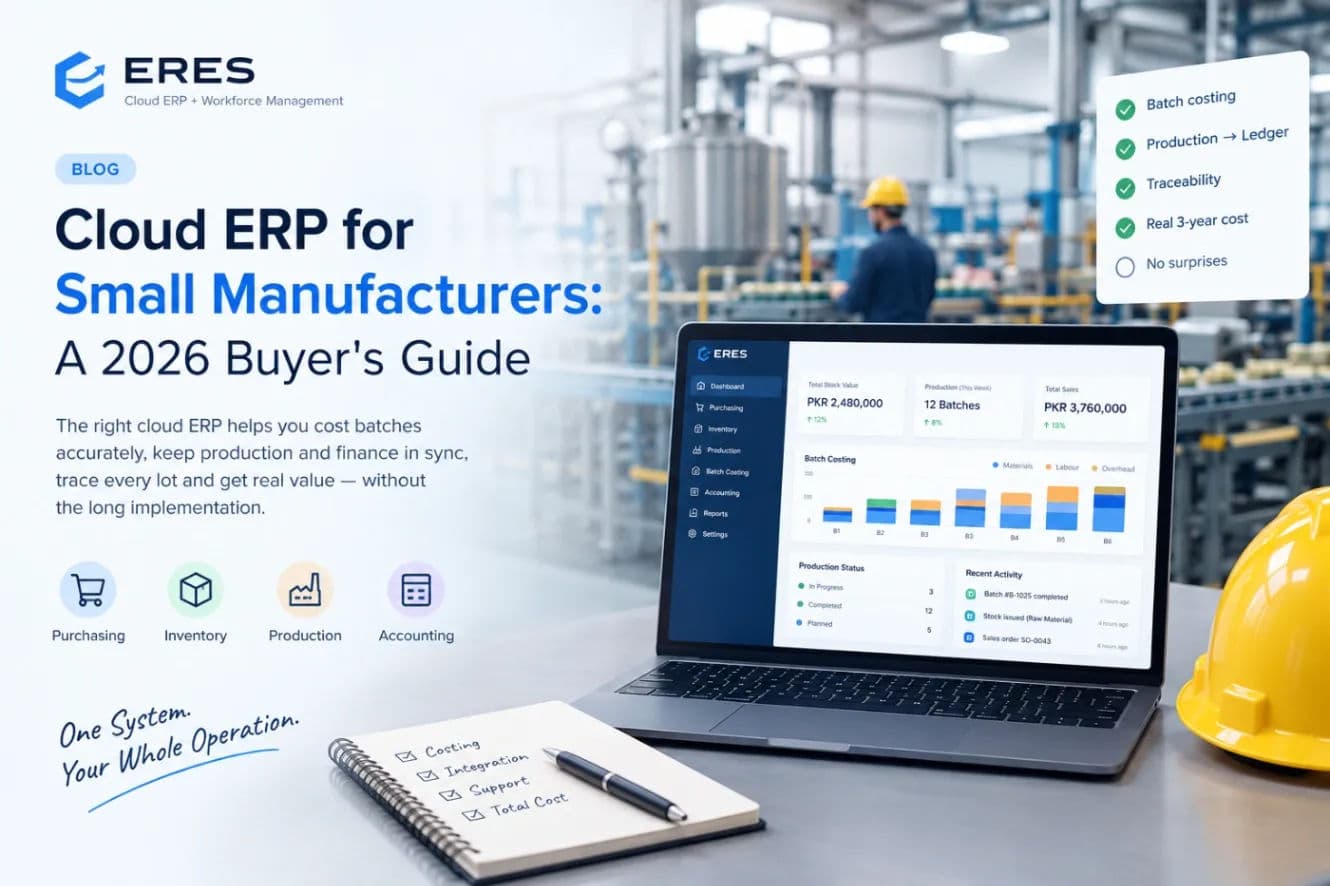
Factory owners in Pakistan often juggle production schedules, raw‑material inventories, labour costs and regulatory compliance on separate spreadsheets or paper registers. The result is duplicated effort, delayed decision‑making and a higher risk of stock‑outs or over‑production. A single, cloud‑based system that links the shop floor to the finance department can remove these bottlenecks and give managers a real‑time view of the entire operation.
Centralise Production Planning
When the production plan is stored in one place, every department can see the same targets and deadlines. This eliminates the need for manual hand‑over of printed schedules.
- Master production schedule (MPS) – define weekly or monthly output targets for each product line.
- Capacity allocation – assign shifts, machines and labour to each order based on availability.
- Automatic roll‑forward – if a batch is delayed, the system recalculates downstream dates and notifies the relevant supervisors.
ERES stores the MPS alongside the chart of accounts, so the financial impact of each production run is calculated automatically.
Track Raw Material Consumption and Stock Levels
Accurate inventory data is the foundation of cost control. By linking purchase orders, receipts and production usage, you can see at a glance how much material is on hand, what is reserved for open work orders, and what needs re‑ordering.
| Item | Opening Stock | Received (Rs) | Consumed | Closing Stock |
|---|---|---|---|---|
| Steel rods (kg) | 12,000 | 3,500 | 4,200 | 11,300 |
| Plastic granules (kg) | 8,000 | 2,200 | 1,800 | 8,400 |
| Electronic components (units) | 15,000 | 5,000 | 4,500 | 15,500 |
The table updates automatically whenever a purchase receipt or a production voucher is posted. Because ERES uses double‑entry accounting, each stock movement creates a corresponding ledger entry, preserving a complete audit trail.
Automate Work‑order Creation and Approval
Manual work‑order forms are prone to errors and often get lost in the shuffle. ERES replaces them with a digital workflow that respects the user’s role and permission set.
- Planner creates a work order from the MPS.
- Supervisor receives an approval request; the order can be accepted, edited or rejected.
- Once approved, the order appears on the shop‑floor tablet, showing required materials, routing steps and expected completion time.
- Operators record start‑ and finish‑times; the system logs labour hours against the order.
- When the order is closed, cost of goods sold (COGS) is posted automatically to the finance ledger.
This end‑to‑end flow eliminates paper trails, reduces re‑work and ensures that every production cost is captured in the financial statements.
Integrate Payroll and Labour Costing
Labour is a major variable cost in most factories. By linking the HR module with production data, you can calculate the true cost of each unit produced.
- Shift‑based salary rules – define hourly rates for day, night and overtime shifts.
- Attendance integration – biometric or manual punch‑in data feeds directly into the payroll engine.
- Labour allocation – the system attributes recorded hours to the relevant work order, producing a per‑order labour cost report.
- Statutory deductions – ERES calculates EPF, EOBI and income‑tax contributions in line with Pakistani regulations.
The result is a single payroll run that reflects both salary obligations and the cost impact on each product line.
Maintain Compliance with Tax and GST
Manufacturing firms must file regular returns with the Federal Board of Revenue (FBR). ERES stores tax settings at the company level, ensuring that every invoice, purchase receipt and expense entry complies with the current GST rates.
- Automatic GST calculation on sales invoices and purchase orders.
- Pre‑configured tax codes for exempt, zero‑rated and standard‑rated items.
- Export‑ready reporting – generate GST‑free invoices for overseas shipments.
- Audit‑ready ledger – each tax‑related transaction carries a reference to the original document, simplifying FBR inspections.
Leverage AI‑driven Insights via the MCP Server
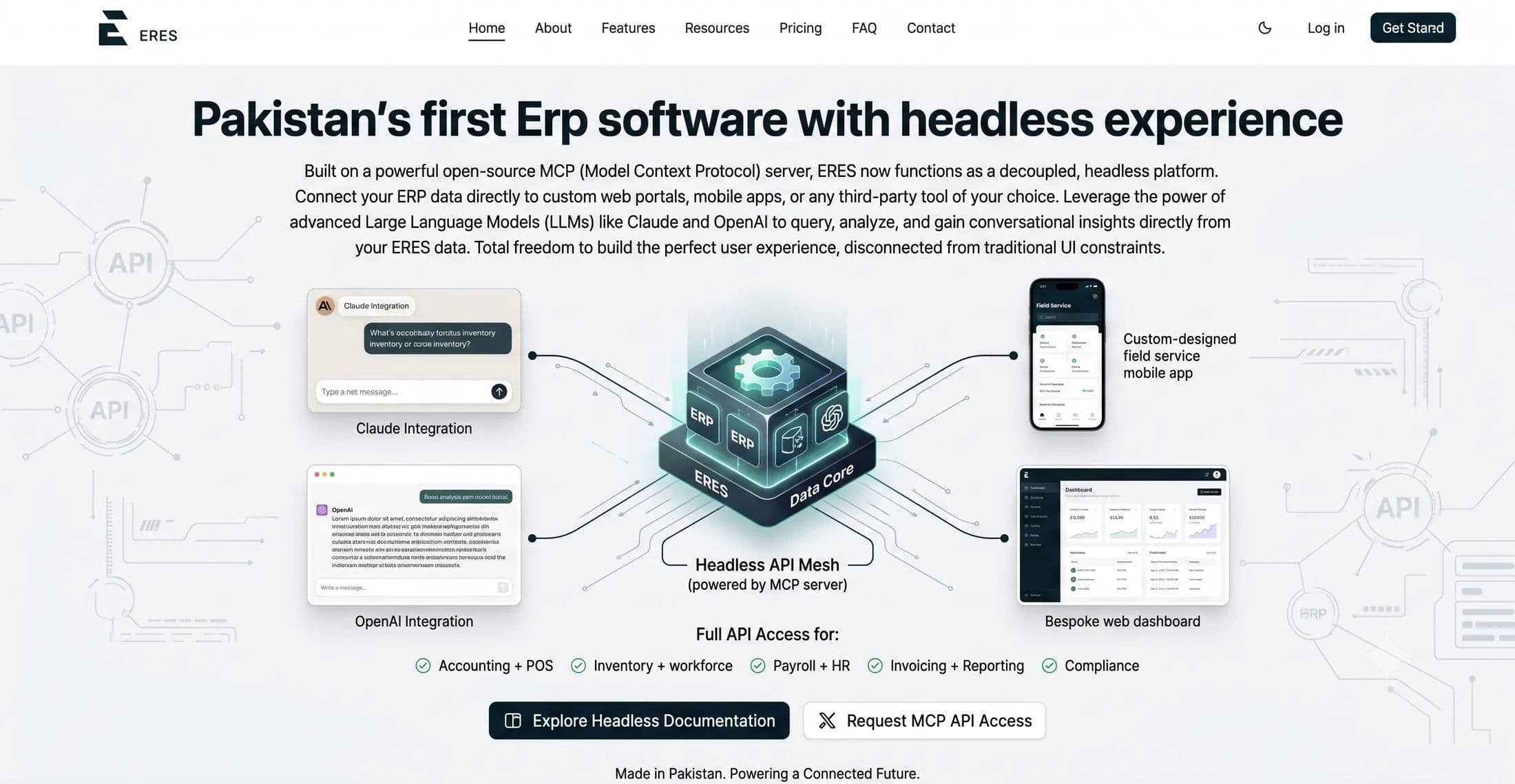
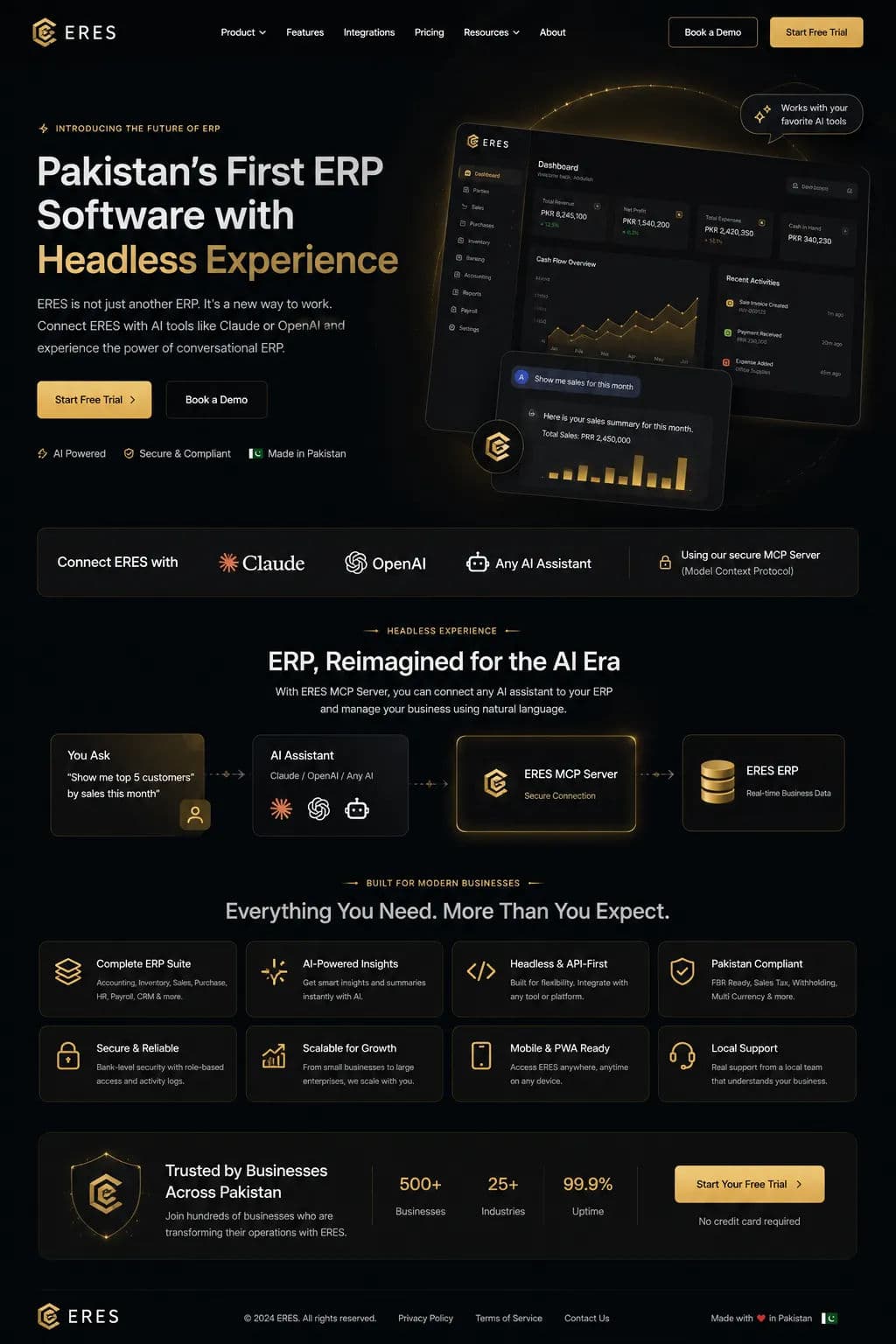
ERES is the first ERP in Pakistan to ship a Model Context Protocol (MCP) server. This allows external AI tools such as ChatGPT, Claude or Cursor to read the accounting books, respect user permissions and suggest journal entries or forecasts.
- Smart entry suggestions – ask the AI to “record depreciation for the past quarter” and receive a ready‑to‑post voucher.
- Demand forecasting – feed recent sales and inventory data to an AI model that predicts material requirements for the next month.
- Variance analysis – request a summary of why actual production costs deviated from the budget, and the AI will pull the relevant ledger and work‑order data.
- Role‑based access – the MCP respects the same permissions set in ERES, so a junior accountant only sees entries they are allowed to view.
These capabilities turn raw data into actionable recommendations without exposing sensitive information.
Conclusion
Managing a factory in Pakistan no longer has to rely on disparate spreadsheets, manual ledgers and ad‑hoc email chains. By centralising production planning, inventory control, work‑order approval, payroll and tax compliance in a single cloud platform, you gain real‑time visibility and a reliable audit trail. The added AI integration through ERES’s MCP server brings predictive insights that help you stay ahead of demand and control costs. Implementing such an integrated system transforms the factory floor from a collection of silos into a coordinated, data‑driven operation.
Run your books on ERES
Accounting, inventory, POS, manufacturing, payroll and tax in one system — and an MCP server so your AI agent can use it too.