Manufacturing ERPfor factories and production plants
Recipes and bills of materials, work orders, stage-by-stage production, quality control, lot traceability and true batch costing — in the same ERP that runs your accounts, inventory, purchases, sales and payroll.
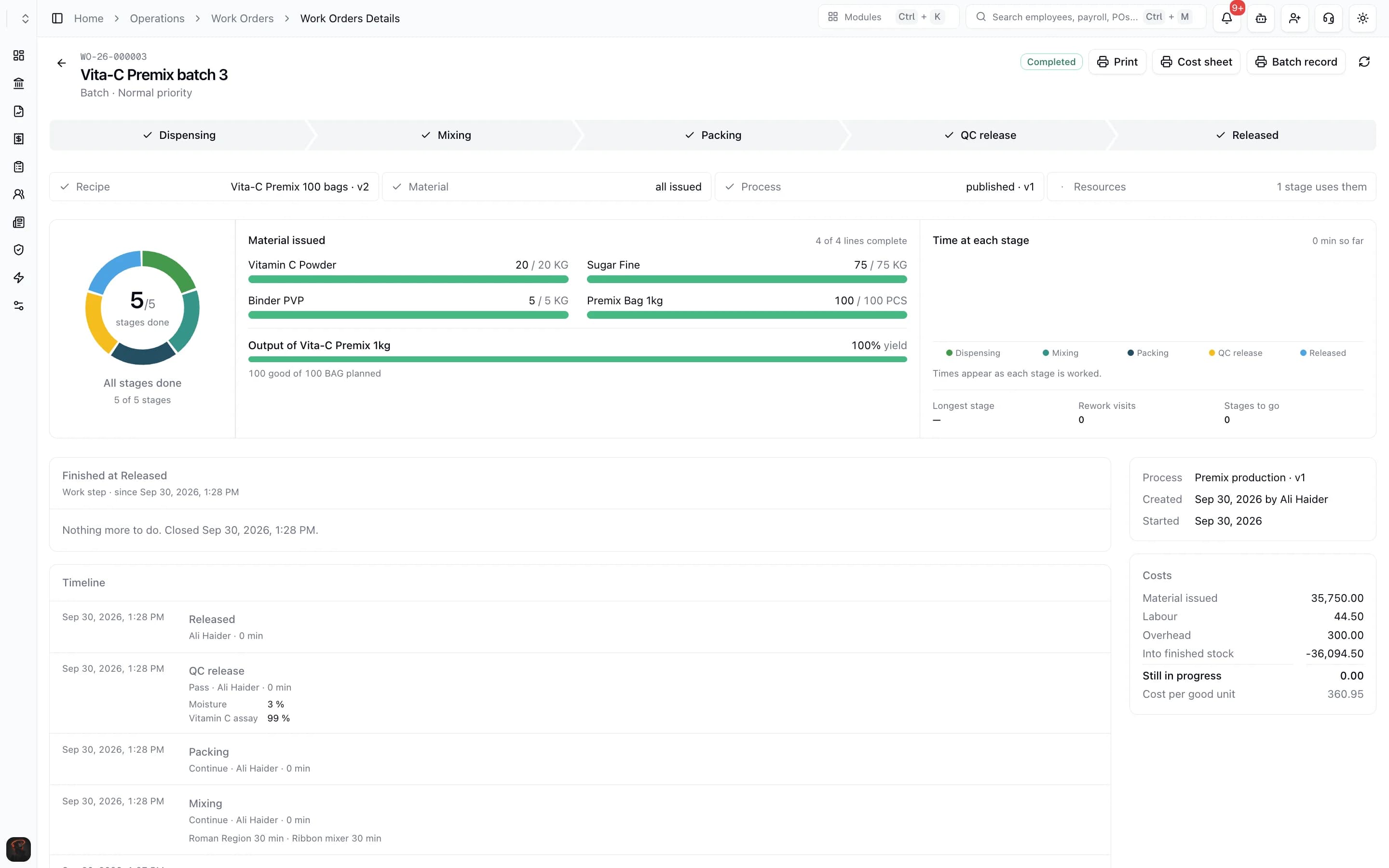
Production software for every kind of factory
You design the process, so the same module runs a three-stage mixing line, a pharmaceutical batch with QC release, or a multi-machine parts route.
Pharmaceuticals & nutraceuticals
Batch manufacturing records, lot and expiry tracking, FEFO issue, potency-adjusted actives and QC release before a batch can be sold.
Animal feed & poultry feed mills
Formulas as % of batch, bags as the output unit, nutrient specs per species and stage, and a least-cost optimiser that finds the cheapest mix at today's ingredient prices.
Food & beverage
Recipes with yields and process loss, packaging consumed at filling, expiry-dated finished lots and a recall report in one click.
Chemicals, paints & coatings
Mixed units (kg, litre, drum), density conversions, inspection readings against limits and rework routes when a batch fails.
Auto parts & engineering
Multi-stage routes across machines and work centres, machine and operator minutes costed per job, scrap and variance per order.
Plastics & packaging
Resin and masterbatch recipes, by-products and regrind credited back to stock, and output received into finished-goods batches.
Textiles & garments
Cutting, stitching and finishing as process stages, piece-rate labour per good unit, and piece-rate earnings flowing into payroll.
Cosmetics & personal care
Formulations as % of batch, filling and labelling stages that take packaging, QC holds and lot-level traceability to the customer.
From purchase order to finished lot, on one ledger
Raw material in, finished goods out — and every movement in between posted to your books as it happens.
Buy raw material
Purchase orders receive stock into batches with a cost, supplier lot and expiry date.
Write the recipe
A versioned bill of materials in any unit — or as % of the batch — with a live cost.
Design the process
Your own stages: dispensing, mixing, packing, QC, release — published once, reused on every batch.
Run the batch
A work order moves stage by stage. Material leaves stock and WIP is posted as each stage is finished.
Inspect and release
QC readings are checked against your limits. A fail holds the lot and routes the batch back for rework.
Sell the finished lot
Good units land in a new finished-goods lot at true cost, ready for sales orders and POS.
Recipes and bills of materials that match the factory floor
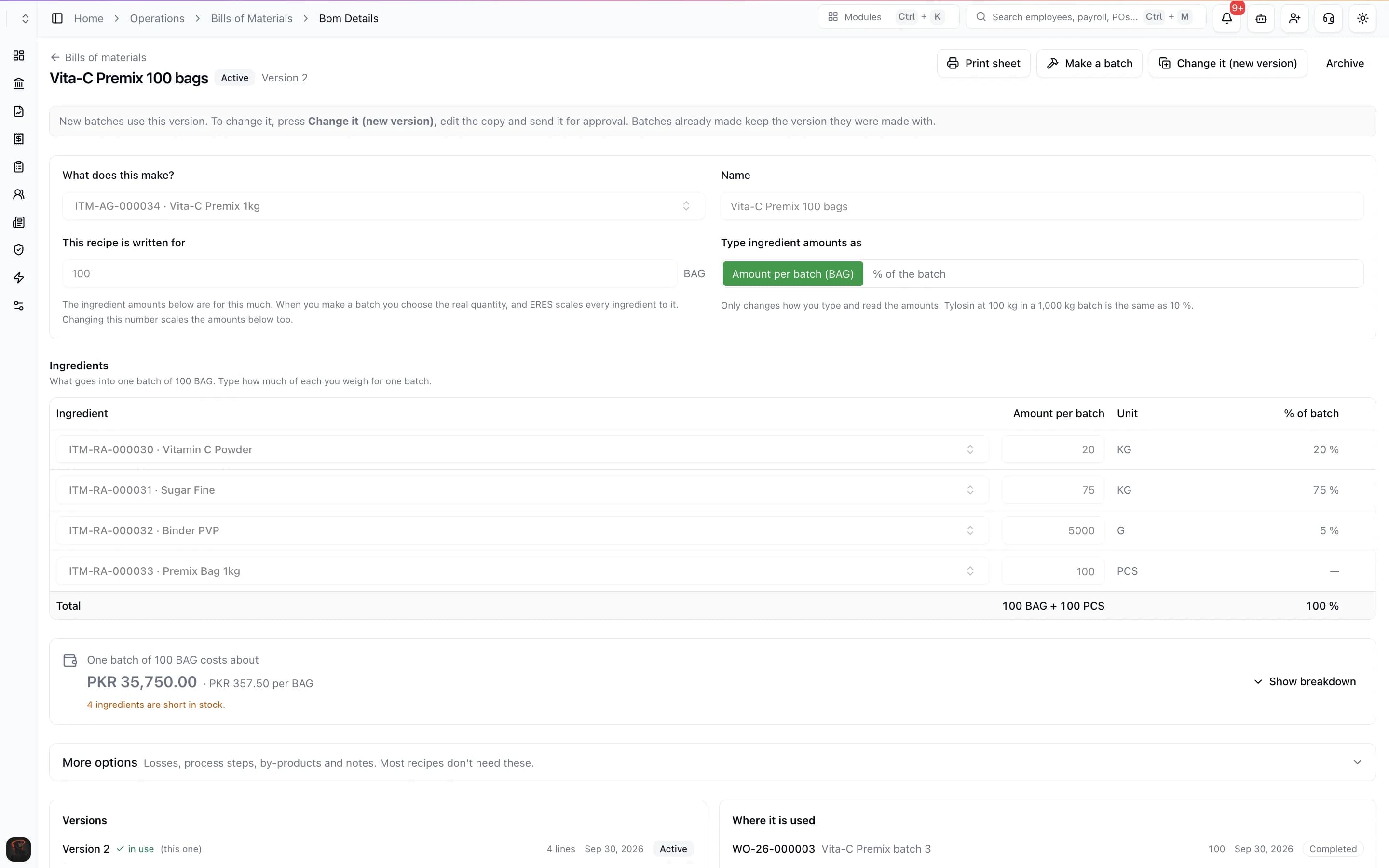
Write the formula the way your production team already does — 20 kg of this, 5,000 g of that, 100 bags — or switch to % of the batch. ERES converts units, scales every line to the real batch size and shows what one batch costs at today's stock prices.
- Kg, g, litre, pieces, bags or % of batch on the same recipe
- Versioning — running batches keep the version they started with
- Recipe approval with a separate approver (four-eyes) when you need it
- Ingredient substitutes, by-products and expected process loss
- Paste a formula straight from a spreadsheet
Your production route, not a generic template
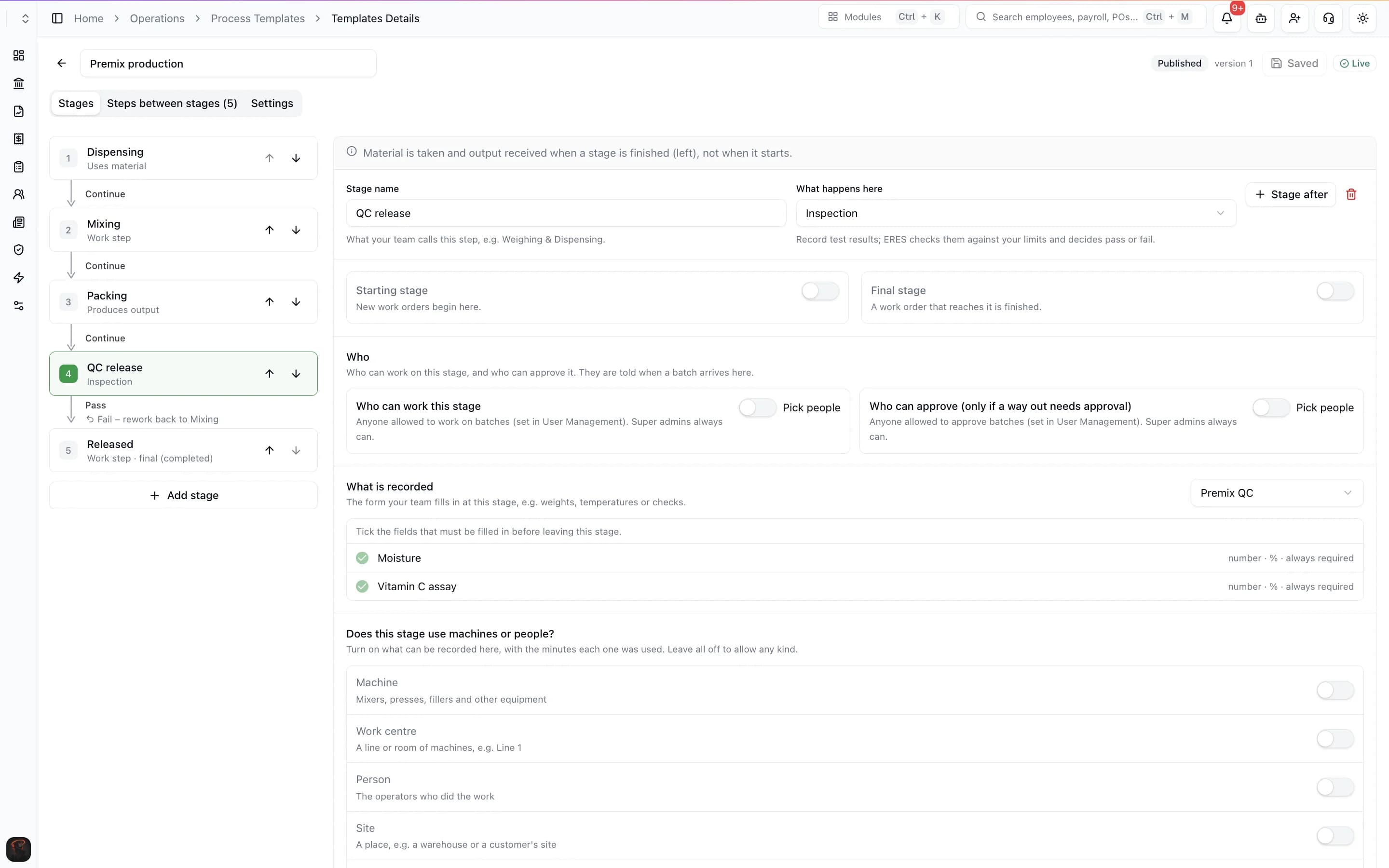
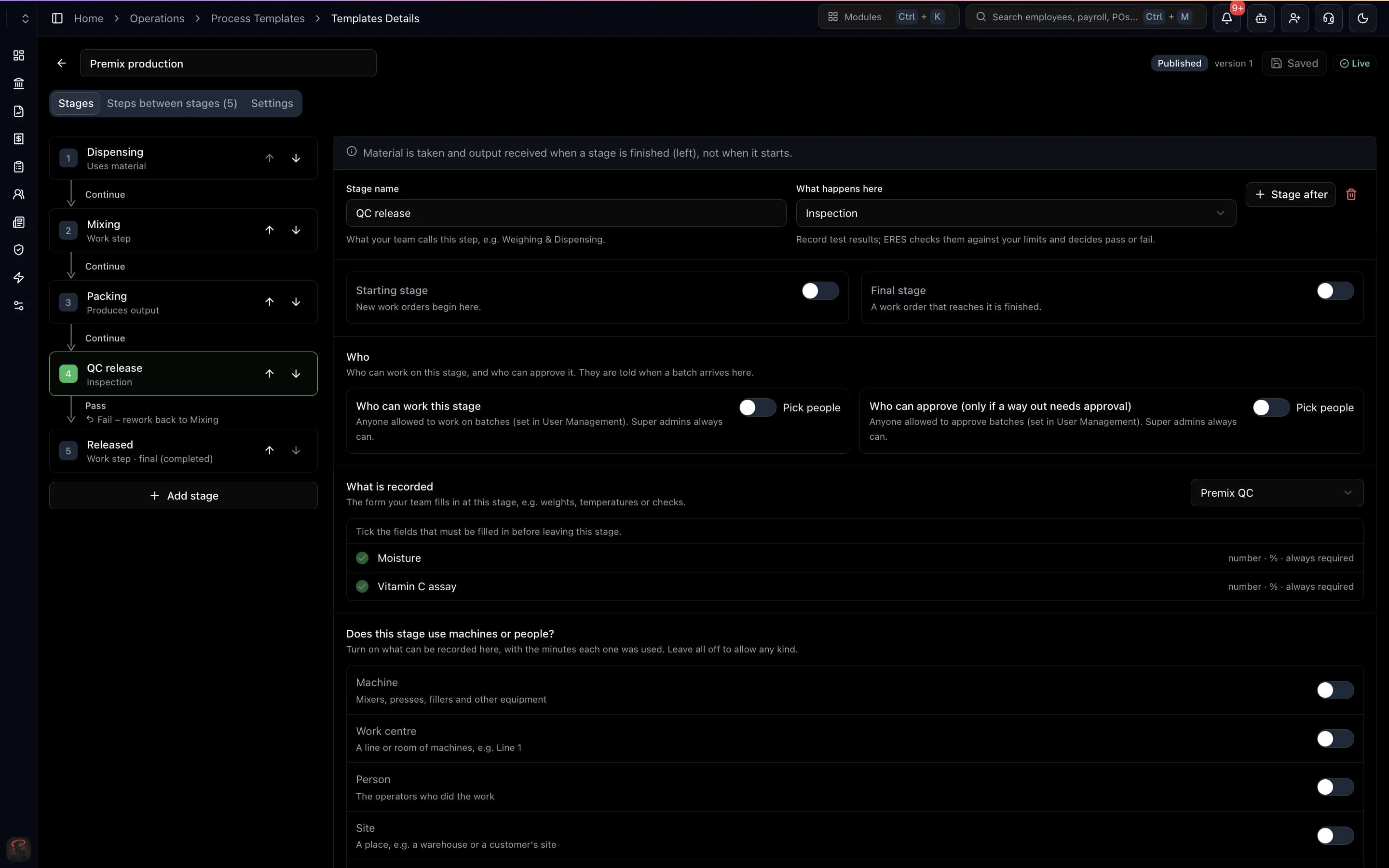
Build the stages a batch goes through and say what each one does: uses material, a work step, produces output, inspection or approval. Attach a QC form with required readings, choose who may work and approve each stage, and define where a failed batch goes back to.
- Stage kinds: material, work, output, inspection, approval
- QC forms with required readings and pass / fail limits
- Fail routes back to an earlier stage for rework
- Machines, work centres, people and tools per stage
- Stage-level permissions and approvers
Know what's short before the line stops
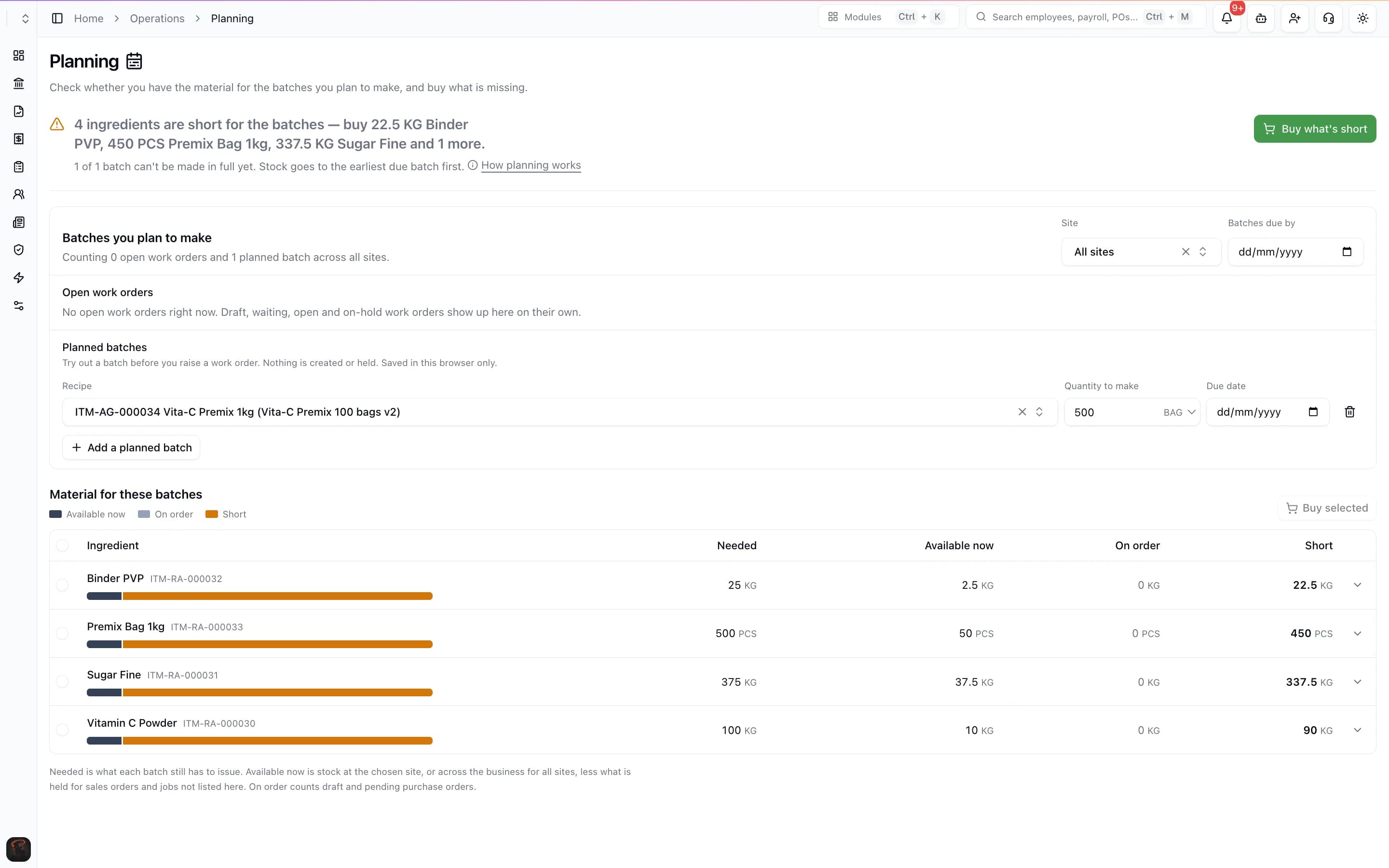
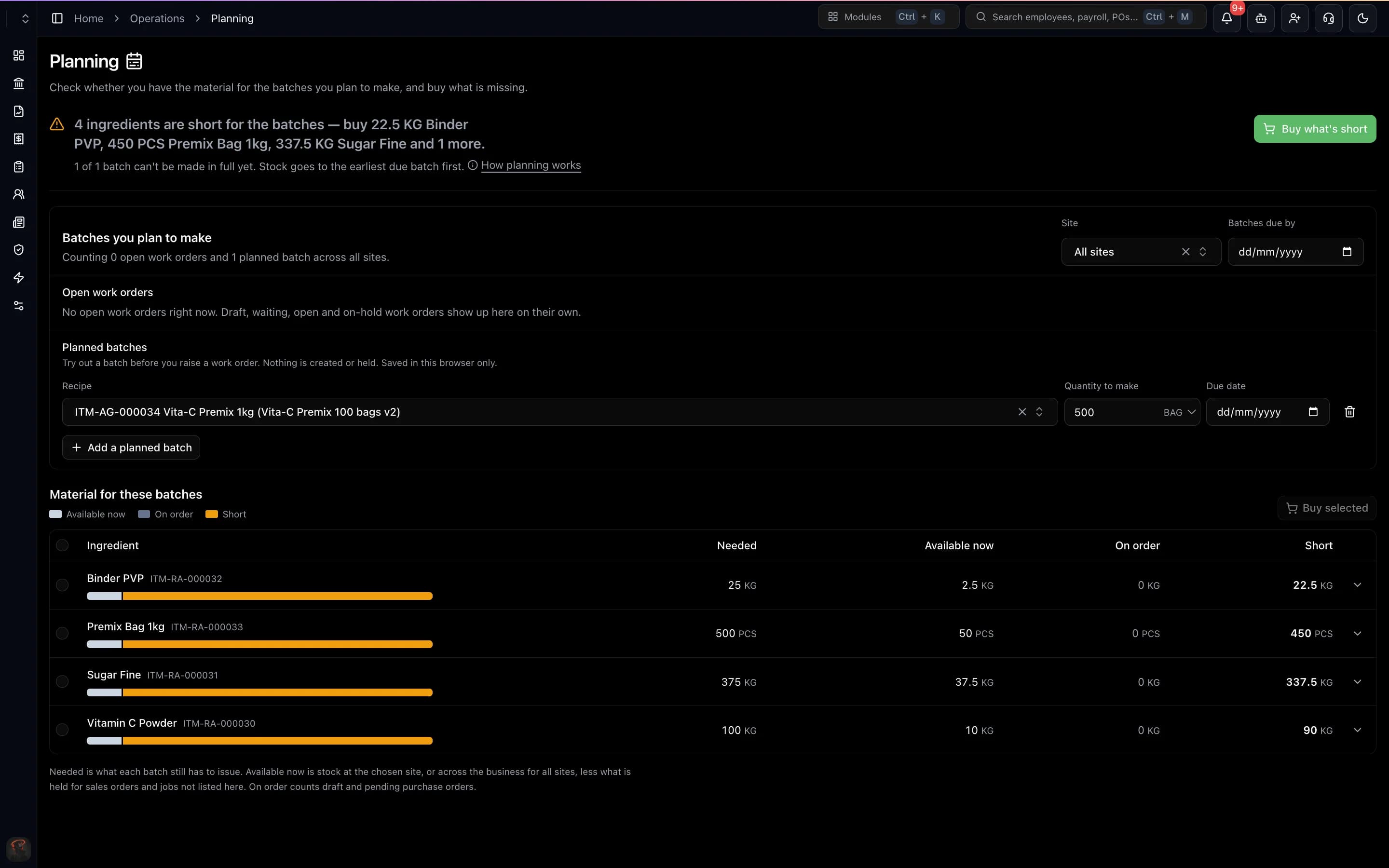
Planning adds up what every open and planned batch still needs, nets it against stock, reservations and what is already on order from suppliers, and shows the gap. Try a batch as a what-if, then raise the purchase order for what's short in one click.
- Needed vs available vs on order vs short, per ingredient
- What-if planned batches that hold no stock
- Filter by site and due date
- Earliest-due batch gets the stock first
- Buy what's short straight into a purchase order
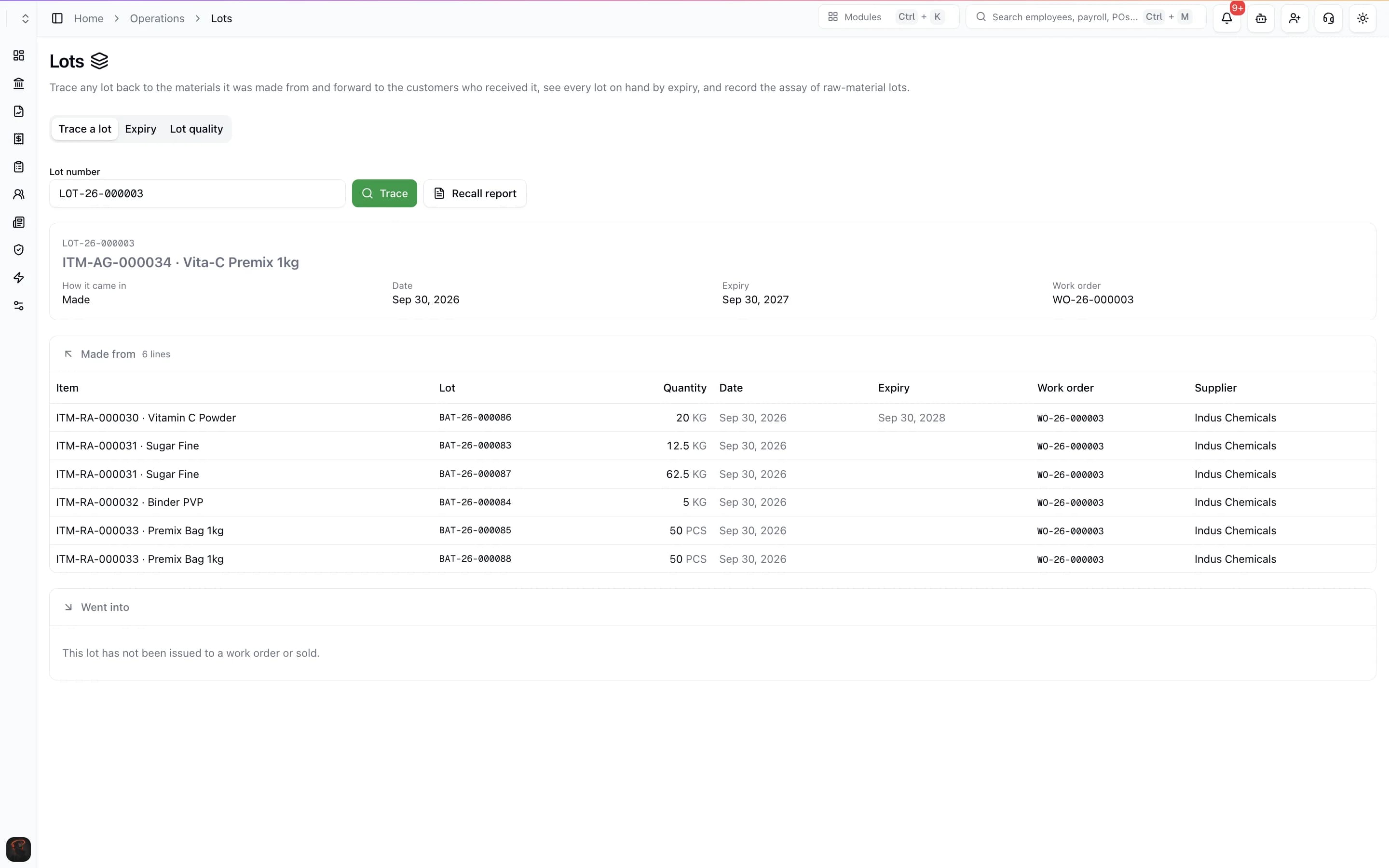
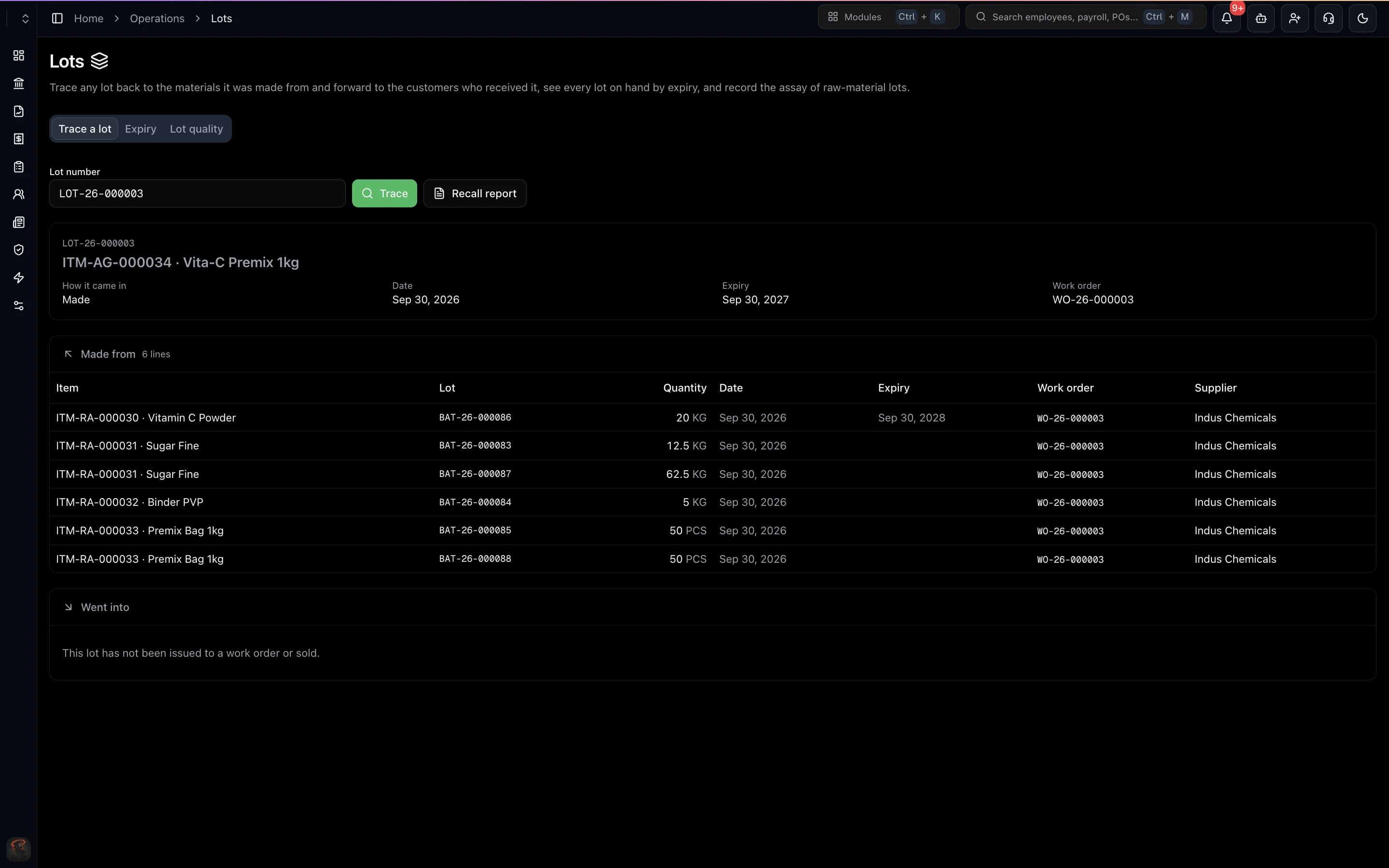
Trace any lot backwards and forwards in seconds
Every finished lot remembers which raw-material batches, suppliers and expiry dates went into it — and every sale remembers which lot it shipped from. When a supplier flags a bad delivery, the recall report tells you exactly which batches and customers are affected.
- Automatic lot numbers for produced batches
- Expiry dates and first-expiry-first-out (FEFO) issue
- Potency / assay recorded per raw-material lot
- Backward trace to suppliers, forward trace to customers
- One-click recall report
The real cost of every batch, posted to the ledger
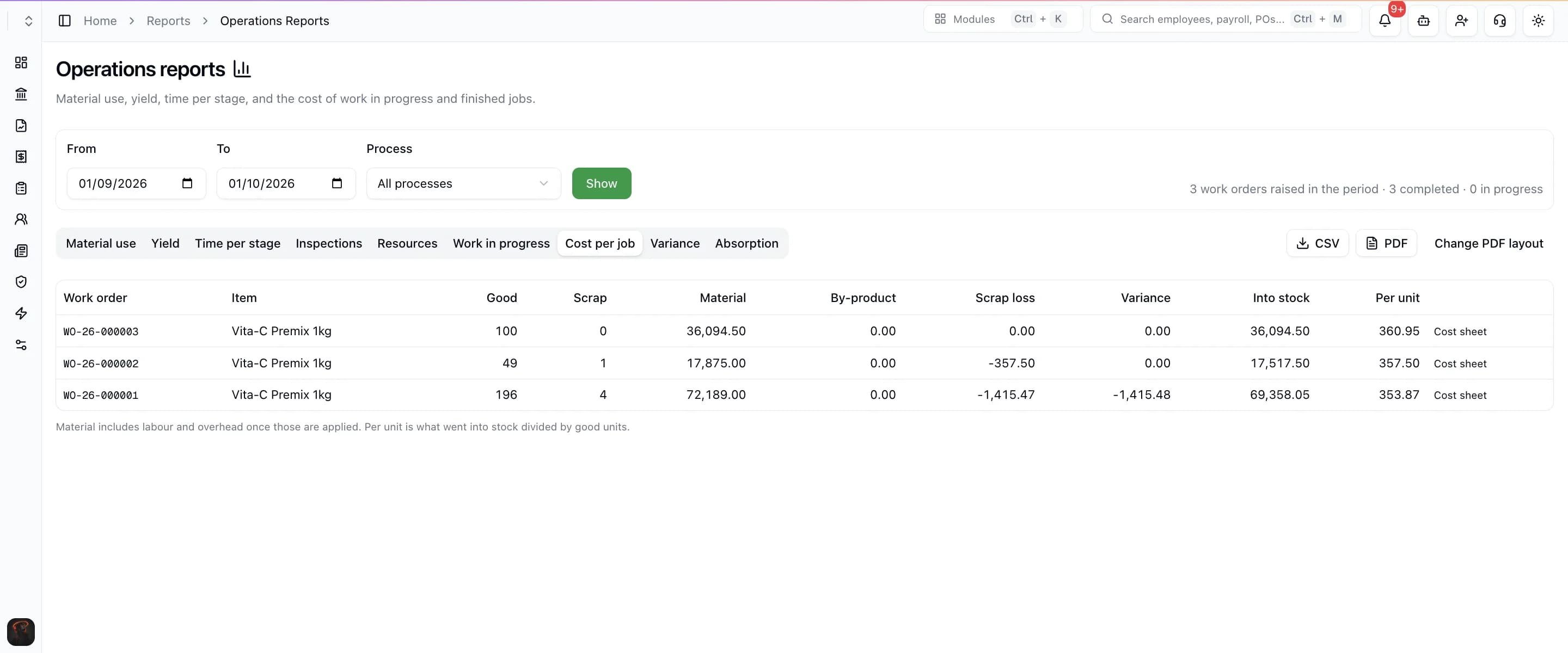
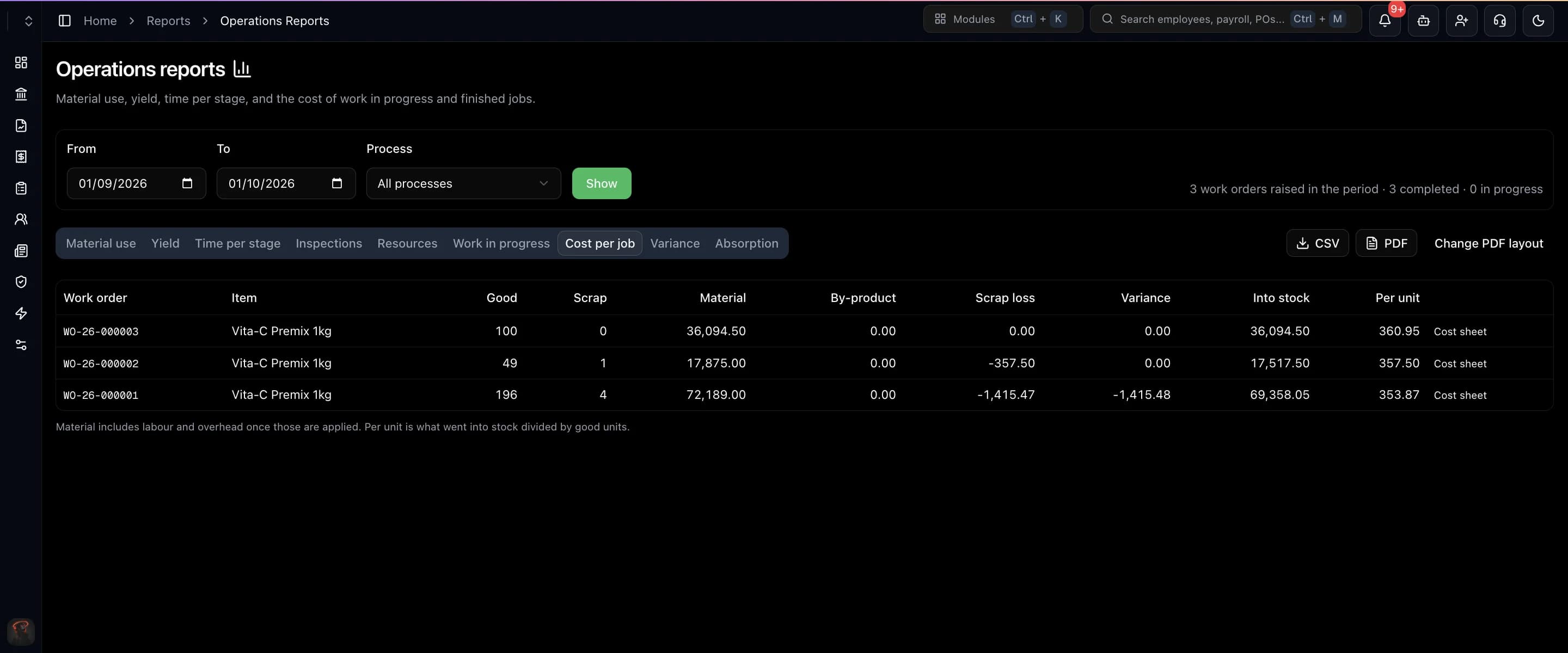
Material at the cost of the exact batches issued, labour and machine time at their hourly rates, overhead per labour hour, abnormal scrap and by-product credits — rolled into the finished lot's unit cost. Every movement is a balanced voucher in your books, not a spreadsheet afterwards.
- Cost sheet PDF per batch with margin against sell price
- Material, yield, time per stage, WIP, variance and absorption reports
- Work in progress, scrap, applied labour and overhead accounts
- Piece-rate earnings proposed in payroll, never paid twice
- CSV and PDF export on every report
Least-cost formulation, inside the recipe
Keep a nutrient library and ingredient values, write a specification per species and stage, and let the optimiser find the cheapest mix that meets it at today's purchase prices. Shadow prices show which limit is costing you money; entry prices show the price at which an unused ingredient would come in. The accepted mix becomes the next recipe version — and the same recipe runs the batch, the lots and the costing.
Nutrient library
Protein, energy, amino acids, minerals — per industry starter sets
Specs & ratios
Min / max per nutrient plus ratios such as Met+Cys : Lys
LP optimiser
HiGHS solver, ingredient limits, infeasibility explained in plain words
What-if prices
Re-run the mix on a quote before the truck arrives
Everything a production plant needs
Least-cost formulation
Nutrient specs, ingredient limits and an LP optimiser with shadow prices
Lot & batch tracking
Every receipt and output in its own lot with cost and expiry
QC holds
A failed inspection locks the batch until it passes
Batch manufacturing record
Printable BMR with stages, readings, people and times
Cost sheet per batch
Ingredients, labour, overhead, scrap and cost per unit
Unit conversions
Buy in kg, issue in g, sell in bags or bottles
Potency adjustment
Scale actives to the assay of the lot being issued
Scrap & by-products
Normal loss, abnormal scrap and by-product credits
Labour & machine time
Minutes per operator and machine, costed into WIP
Piece rate to payroll
Per-unit earnings proposed in the next payroll run
Approvals
Work order and recipe approval with a separate approver
Multi-site production
Plants and warehouses with stock tracked per site
Automatic accounting
Every stage posts a balanced voucher — WIP to finished goods
Production costing your accountant can audit
Standalone production software leaves finance to rebuild the numbers at month end. In ERES every stage of a batch posts a balanced voucher, so work in progress, finished goods and cost of goods sold are always in your balance sheet and income statement — with the batch it came from attached.
| Event | Debit | Credit |
|---|---|---|
| Material issued at a stage | Work in progress | Raw material stock |
| Labour and machine time | Work in progress | Applied labour / overhead |
| Good units received | Finished goods stock | Work in progress |
| Scrap above allowance | Scrap and process loss | Work in progress |
| Batch completed with leftover WIP | Operations variance | Work in progress |
Manufacturing ERP questions, answered
What is ERES Factory Operations?
ERES Factory Operations is the manufacturing module of the ERES ERP. It manages recipes and bills of materials, production process templates, work orders, quality control, lot and expiry tracking, material planning and batch costing, and posts every production movement to the same ledger as your accounting, inventory, purchases and sales.
Which types of factories can use ERES manufacturing ERP?
Any batch or process manufacturer: pharmaceutical and nutraceutical plants, animal and poultry feed mills, food and beverage, chemicals and paints, cosmetics, plastics and packaging, textiles and garments, and auto parts or engineering workshops. Because you design your own process stages, the same module fits a three-stage mixing line or a ten-stage assembly route.
Does ERES calculate the cost of each production batch?
Yes. A batch is costed from the actual raw-material lots issued, labour and machine minutes at their hourly rates, overhead per labour hour, abnormal scrap and by-product credits. The result becomes the unit cost of the finished lot, and a cost sheet PDF shows the full build-up and margin against the sell price.
Can I trace a finished product back to its raw materials?
Yes. Every finished lot records the raw-material batches, suppliers and expiry dates it was made from, and every sale records the lot it shipped from. A recall report lists the affected batches and customers for any lot.
Does it support recipes in percentages and mixed units?
Yes. A recipe can be written as amounts per batch or as a percentage of the batch, and lines can use different units such as kg, grams, litres, pieces or bags. Unit conversions are set per item, so you can buy in kg, issue in grams and sell in bags.
How does quality control work in ERES?
Add an inspection stage to your process and attach a QC form with the readings that must be recorded, such as moisture or assay. Readings are checked against your limits; a failed inspection places the batch on QC hold and can route it back to an earlier stage for rework, and a pass releases it for sale.
Is ERES manufacturing software integrated with accounting and inventory?
Yes. Factory Operations runs on the same ledger as ERES accounting, inventory, purchases, sales, POS and payroll. Material issues, work in progress, finished goods, scrap, applied labour and variance are posted automatically as balanced vouchers, so there is no separate costing spreadsheet to reconcile.
Does ERES include feed formulation software?
Yes. The Nutrients and Formulation tabs on the recipe module hold a nutrient library, ingredient nutrient values (paste from Excel), nutrient specifications with minimum, maximum and ratio limits, and a least-cost optimiser that finds the cheapest mix meeting the specification at current ingredient prices. The result is written into a draft recipe version that still goes through recipe approval, and the same recipe then drives work orders, lots and batch costing.
Can I plan raw material purchases for upcoming production?
Yes. The planning screen adds up what every open and planned batch still needs, compares it with stock, reservations and open purchase orders, and shows what is short. You can then create a purchase order for the shortfall in one click.