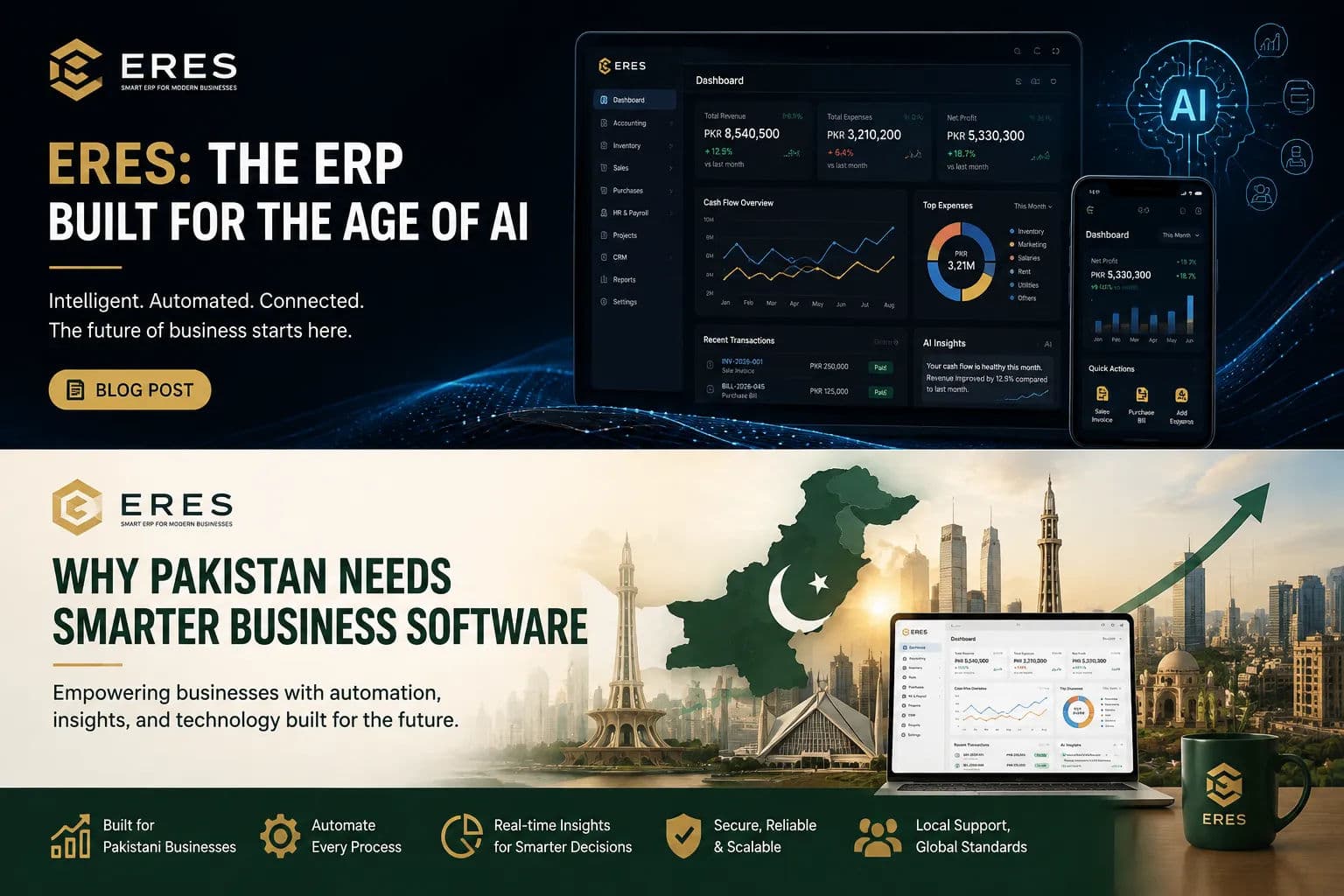
Why Pakistan Needs Smarter Business Software?
Businesses across Pakistan still rely on paper ledgers, spreadsheets and a patchwork of disconnected tools. The result is duplicated effort, delayed reporting and a high risk of non‑compliance with the Federal Board of Revenue (FBR). When the same data must be entered into an invoicing system, a payroll register and a tax return, errors multiply and decision‑makers lose the real‑time insight they need to grow. Smarter business software can eliminate these bottlenecks, but the solution must be built for the local regulatory environment, support multiple functions, and allow secure, role‑based access.
Businesses across Pakistan still rely on paper ledgers, spreadsheets and a patchwork of disconnected tools. The result is duplicated effort, delayed reporting and a high risk of non‑compliance with the Federal Board of Revenue (FBR). When the same data must be entered into an invoicing system, a payroll register and a tax return, errors multiply and decision‑makers lose the real‑time insight they need to grow. Smarter business software can eliminate these bottlenecks, but the solution must be built for the local regulatory environment, support multiple functions, and allow secure, role‑based access.
1. Manual processes cripple accounting accuracy
Most small and medium enterprises (SMEs) still maintain their accounting books in Excel or even on paper. While familiar, this approach suffers from three practical drawbacks:
- Data duplication – every transaction is recorded in the sales register, the inventory sheet and the cash book, creating three points of failure.
- Delayed reconciliations – month‑end closing can take days or weeks, leaving managers without up‑to‑date cash‑flow information.
- Limited audit trail – changes are not timestamped or linked to a user, making internal audits and external inspections difficult.
Modern software erp solutions automate double‑entry accounting, generate a single source of truth, and produce trial balances instantly. For a typical trading business, moving from a spreadsheet to an integrated ERP can reduce bookkeeping time by up to 60 % – a concrete efficiency gain that frees staff to focus on analysis rather than data entry.
2. Local tax and GST rules demand specialised configuration
The FBR’s tax framework is complex: sales tax, withholding tax, and the newly introduced GST each have distinct filing frequencies, exemption lists and rate structures. Generic international platforms often require custom scripting or third‑party add‑ons, which adds cost and risk.
A locally‑developed ERP can embed the exact tax tables used by the FBR, automatically calculate tax on each invoice and generate ready‑to‑file returns. This removes the need for separate “quick books”‑style add‑ons and ensures that every transaction complies with the latest circulars.
Key tax‑related features to look for include:
- Dynamic tax rate lookup based on product code.
- Automatic withholding tax deduction at source.
- Pre‑filled GST returns with line‑by‑line reconciliation.
When the software handles these calculations, accountants spend less time correcting manual errors and more time advising on cash‑flow optimisation.
3. Integration across inventory, POS and payroll removes silos
Business functions rarely operate in isolation. A sale recorded at the point of sale (POS) should instantly reduce stock levels, update cost of goods sold and trigger a payroll entry for commission or overtime. Without integration, staff must perform manual journal entries, increasing the chance of mismatched figures.
Comprehensive ERP systems link the following modules:
- Inventory management – real‑time stock visibility, batch tracking and reorder alerts.
- POS – receipt printing, barcode scanning and immediate posting to the general ledger.
- Payroll & HR – salary calculations, statutory deductions and employee self‑service portals.
When these modules share a single database, a retailer can see the impact of a promotional discount on both inventory turnover and payroll commissions within minutes. The resulting insight supports more accurate budgeting and pricing decisions.
4. Role‑based AI assistance through the Model Context Protocol (MCP)
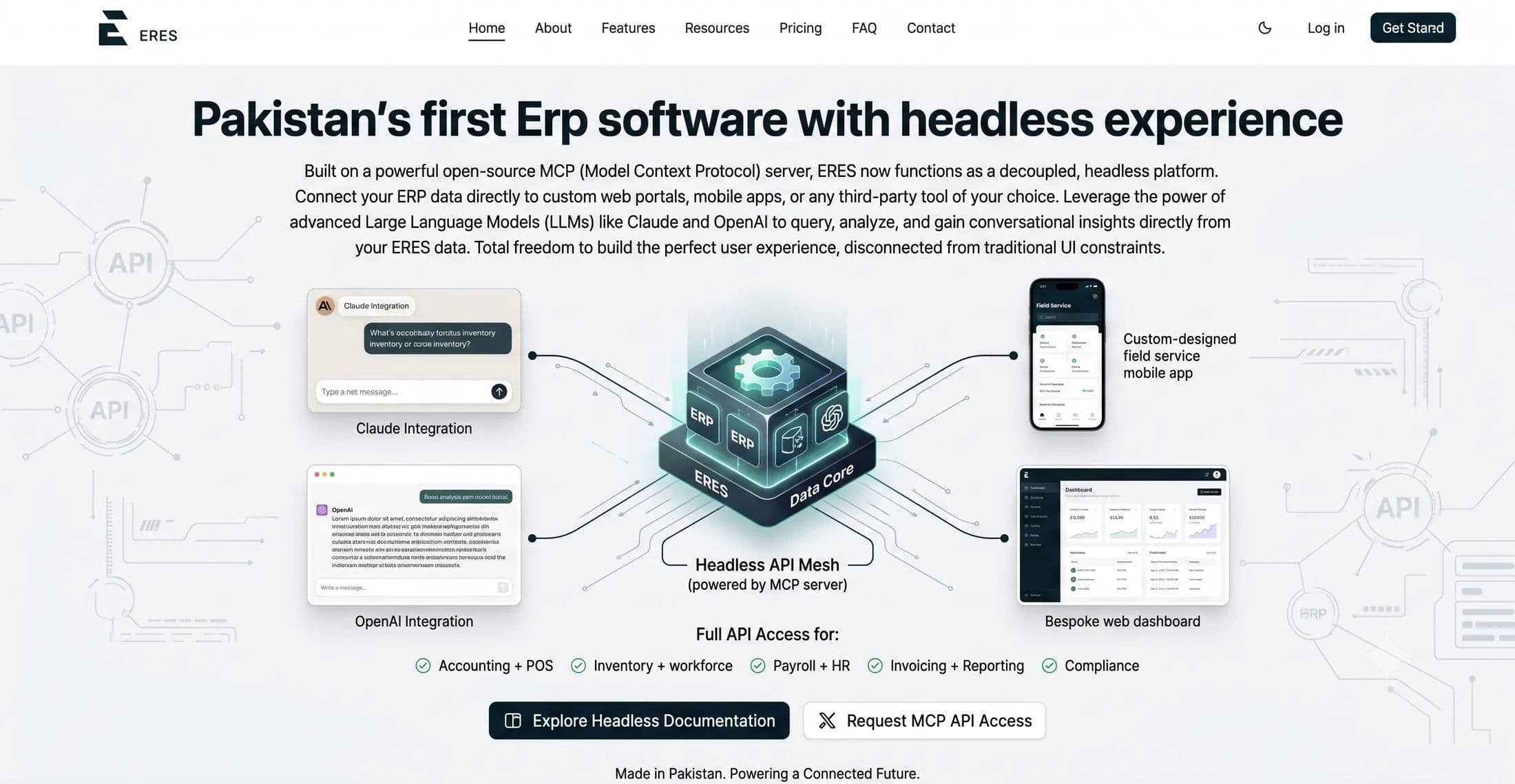
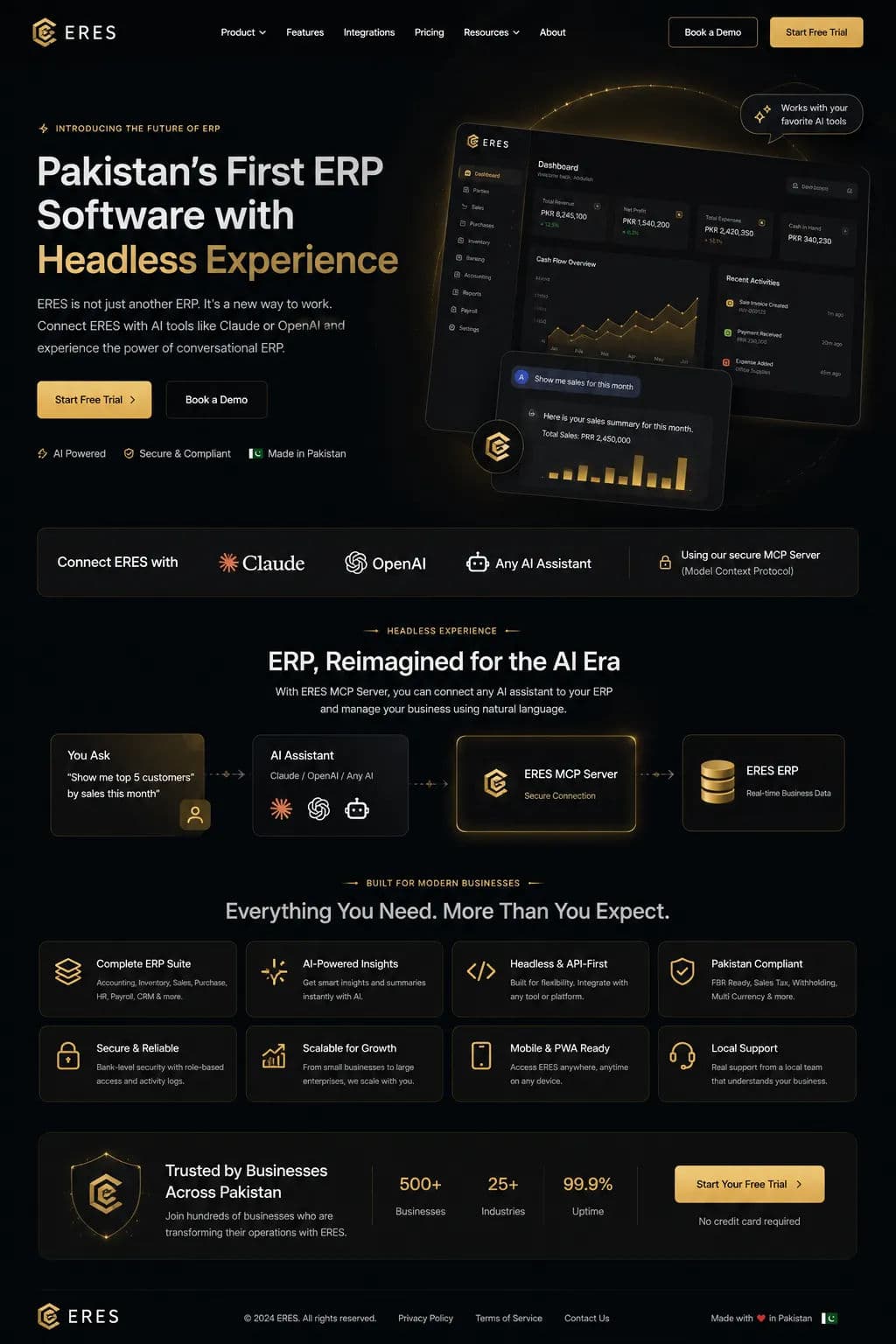
ERES has introduced Pakistan’s first MCP server, allowing large language models such as ChatGPT, Claude and Cursor to read a company’s accounting books and prepare journal entries according to each user’s role and permissions. This capability turns AI from a generic chatbot into a specialised accounting assistant.
Practical uses include:
- Generating routine monthly accruals after the system analyses prior periods.
- Suggesting corrective entries when a transaction violates internal controls.
- Answering “what‑if” queries, e.g., “What will cash flow look like if we increase sales by 10 % next quarter?”
Because the MCP respects the ERP’s permission matrix, a junior accountant can request assistance without exposing sensitive senior‑level data. This bridges the gap between manual expertise and AI speed, while remaining fully compliant with data‑privacy regulations.
5. Cloud deployment delivers scalability and lower total cost of ownership
On‑premise ERP installations require upfront hardware purchases, regular maintenance contracts and specialised IT staff – expenses that many Pakistani SMEs cannot justify. Cloud‑based ERP, delivered as a subscription, spreads costs over time and scales with the business.
A simple cost comparison illustrates the difference:
| Cost Element | On‑Premise ERP | Cloud ERP (generic) | ERES Cloud |
|---|---|---|---|
| Initial hardware | Rs 150,000–250,000 | None | None |
| Annual licence & support | Rs 80,000–120,000 | Rs 60,000–90,000 | Rs 55,000–85,000 |
| IT staff (full‑time) | Rs 500,000+ | Rs 200,000 (part‑time) | Rs 180,000 (part‑time) |
| Scalability (additional users) | High cost per seat | Incremental Rs 5,000 per user | Incremental Rs 4,500 per user |
Beyond cost, cloud ERP provides automatic backups, regular security patches and access from any internet‑connected device – essential for businesses with multiple branches or remote sales teams.
6. Choosing the right ERP for the Pakistani market
When evaluating software, business owners should focus on criteria that directly affect day‑to‑day operations rather than marketing hype. The following checklist helps narrow the field:
- Local tax compliance – Does the system include FBR‑approved tax tables out of the box?
- Multi‑currency support – Even if the primary currency is Rs, can the software handle foreign‑currency invoices for import/export?
- Role‑based permissions – Are users limited to the data they need to see?
- API and integration capability – Can the ERP connect to existing POS hardware or e‑commerce platforms?
- AI assistance – Is there a secure way to leverage large language models for routine tasks?
- Local support – Is there a Pakistani support team that understands the regulatory environment?
ERES meets each of these points: it ships with FBR‑aligned tax configuration, supports the Pakistan Rupee (displayed as “Rs 2,999” in reports), offers granular role permissions, provides an open API for POS and e‑commerce links, and is the first to embed the MCP server for AI‑driven bookkeeping. While the article is not a sales pitch, these attributes illustrate what a truly local ERP should deliver.
Conclusion
Pakistan’s growing SME sector cannot continue to rely on fragmented spreadsheets and manual ledgers. Inefficient accounting, complex tax rules, siloed operations and limited analytical capability all hinder growth. Smarter business software – built for the local market, hosted in the cloud, and augmented with secure AI assistance – resolves these pain points and equips finance managers with the real‑time insight needed for strategic decision‑making. By adopting an ERP that aligns with Pakistan’s regulatory framework and operational realities, businesses can reduce errors, accelerate reporting and focus on the activities that drive profit.
The limitations of manual accounting and legacy software for Pakistani SMEs
This section outlines how reliance on spreadsheets, paper ledgers and outdated systems hampers accuracy, speed and regulatory compliance.
Why a cloud‑based ERP like ERES is a practical upgrade
It explains how ERES delivers full double‑entry accounting, a configurable chart of accounts and real‑time access to financial data.
Connecting inventory, point of sale and payroll within a single platform
Shows the benefits of eliminating data silos by managing stock, sales and employee wages together, leading to faster reporting.
Built‑in FBR tax and GST configuration simplifies compliance
Describes how the software automatically applies Pakistan’s tax rules, generates statutory reports and reduces audit risk.
AI‑enabled MCP server lets ChatGPT, Claude or Cursor read the books and create entries
Highlights the unique Model Context Protocol that uses the user’s role and permissions to turn accounting books into accurate journal entries.
Choosing the right solution: ERES versus generic software like Quick Books
Compares localised ERP features, support and pricing with off‑the‑shelf accounting software, helping decision‑makers select the most suitable tool.
Run your books on ERES
Accounting, inventory, POS, manufacturing, payroll and tax in one system — and an MCP server so your AI agent can use it too.