How to Calculate the Cost of a Production Batch (With a Worked Example)
A step-by-step guide to batch costing for Pakistani factories — material at lot cost, labour, machine overhead, scrap and by-products — with a worked example and how manufacturing ERP automates it.
Ask most factory owners in Pakistan what one batch of their product really costs and you will get a number from a spreadsheet — usually last month's raw-material prices multiplied by the recipe, with labour and electricity "added on top" as a percentage someone set years ago. That number decides your selling price, your margin and which products you push. If it is wrong by even 5%, you can be selling your best-moving product at a loss without knowing it.
This guide explains how to calculate the true cost of a production batch, step by step, with a worked example — and how manufacturing ERP software does the same calculation automatically for every batch you run.
What goes into the cost of a production batch?
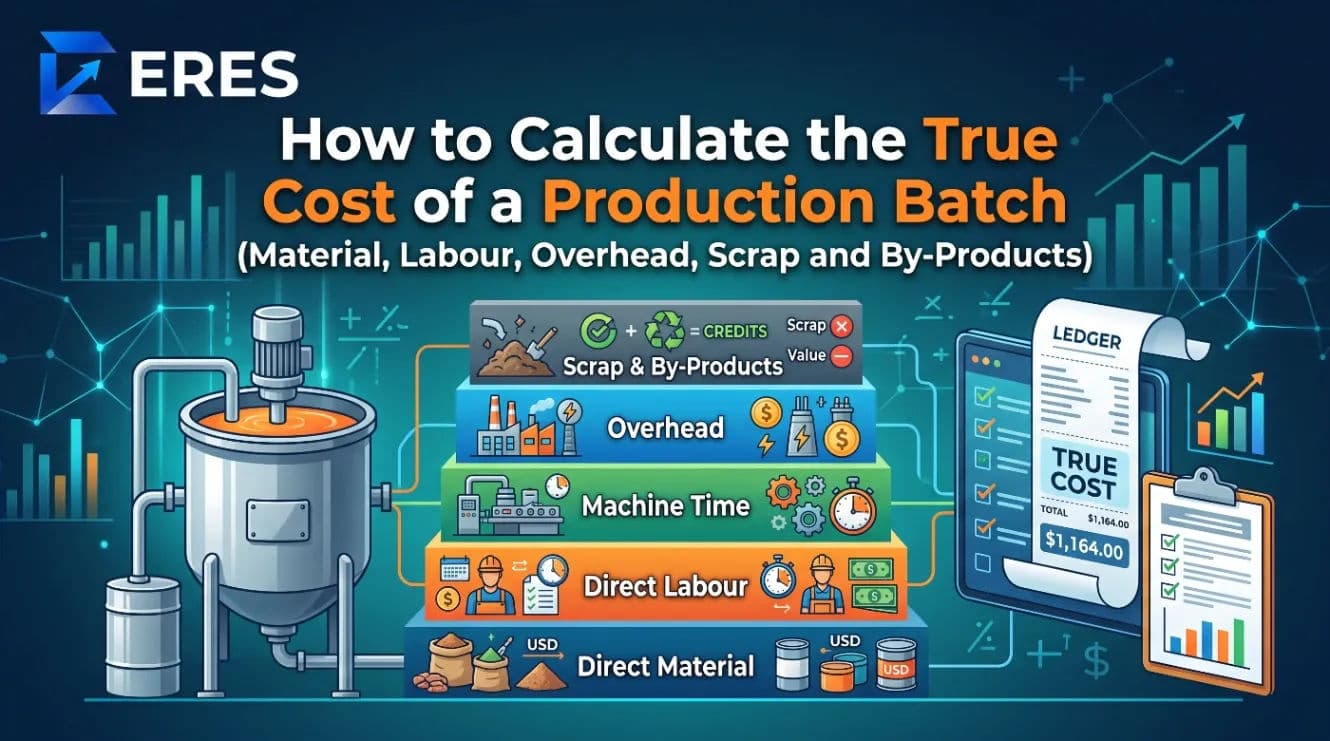
Whether you run a pharmaceutical plant, a poultry feed mill, a food factory or a plastics unit, the cost of one batch is built from the same five parts:
- Raw material — every ingredient and packaging item actually issued to the batch, at the price of the stock it came from (not today's price list).
- Direct labour — operator time spent on the batch, at each person's hourly cost. For piece-rate workers, the rate per good unit produced.
- Machine time and overhead — mixers, presses, fillers and the electricity, maintenance and rent behind them, applied as a rate per machine hour or per labour hour.
- Scrap and process loss — normal loss is part of the cost of good units; abnormal scrap above your allowance is a loss you should see separately.
- By-product credits — anything useful the batch produces besides the main product (bran, regrind, off-cuts) reduces the cost of the main output.
The formula is simple:
Cost per good unit = (material + labour + overhead − by-product credit − abnormal scrap) ÷ good units produced
The hard part is not the formula. It is getting accurate inputs for every batch, every day, without a production clerk rebuilding a spreadsheet at month end.
Worked example: 100 bags of vitamin premix
Take a nutraceutical factory making a Vita-C premix sold in 1 kg bags. The recipe for one batch of 100 bags is:
| Ingredient | Quantity | Share of batch |
|---|---|---|
| Vitamin C powder | 20 kg | 20% |
| Sugar, fine | 75 kg | 75% |
| Binder (PVP) | 5,000 g | 5% |
| Premix bag, 1 kg | 100 pcs | packaging |
Notice the mixed units — kilograms, grams and pieces in one recipe. That is normal on a factory floor, and it is exactly where spreadsheets go wrong.
Step 1: Material at the cost of the stock actually used
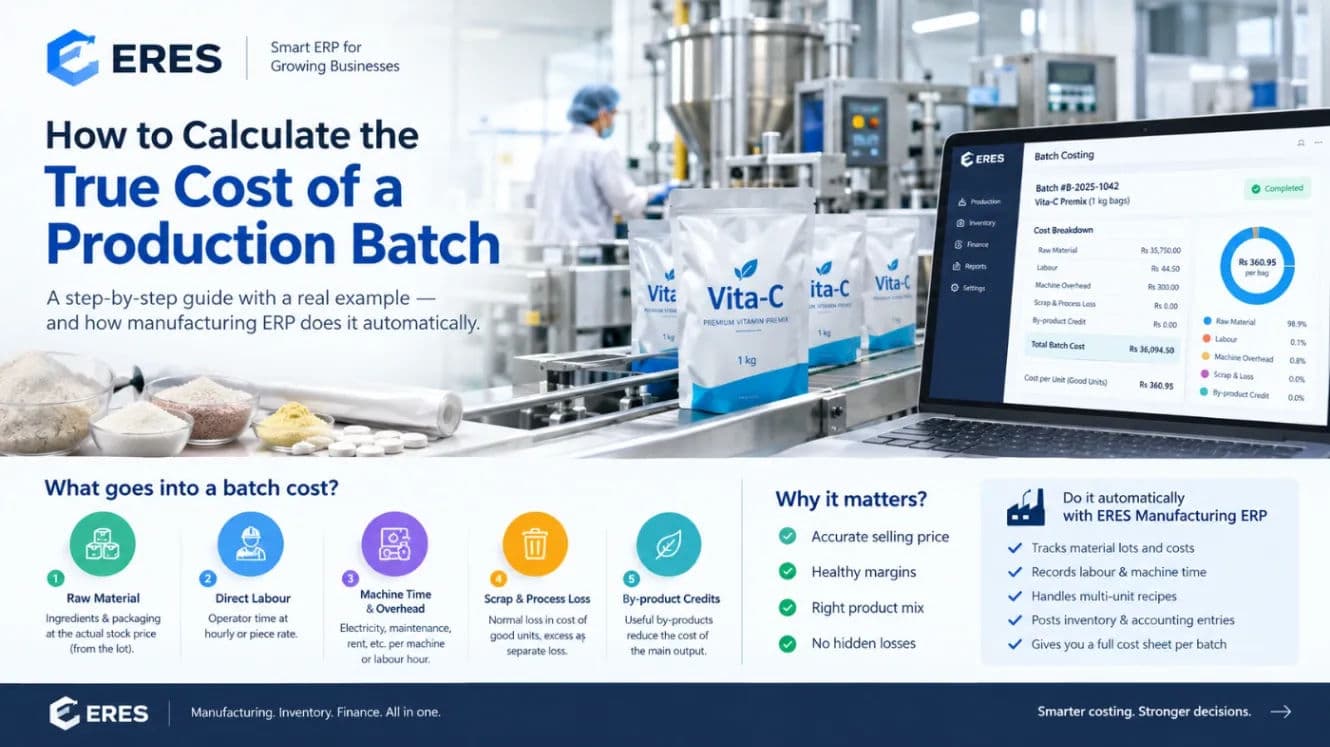
The batch issued material from specific purchase lots. Sugar, for example, came from two lots bought at different prices — 12.5 kg from one and 62.5 kg from another. Costing each lot at its own purchase price gives a material cost of Rs 35,750 for the batch.
Using a single "current price" instead would overstate or understate the batch every time prices move — and in Pakistan, raw-material prices move every month.
Step 2: Labour and machine time
Mixing took 30 minutes of an operator and 30 minutes of the ribbon mixer. At their hourly rates that is Rs 44.50 of labour and Rs 300 of machine overhead.
Step 3: Output, scrap and the unit cost
The batch produced 100 good bags with no scrap:
| Cost element | Amount (Rs) |
|---|---|
| Material issued | 35,750.00 |
| Labour | 44.50 |
| Machine overhead | 300.00 |
| Total batch cost | 36,094.50 |
| Cost per bag (÷ 100) | 360.95 |
Now compare two other batches of the same product. One produced 49 good bags and 1 bag of scrap, at Rs 357.50 per bag. Another produced 196 good bags and 4 of scrap, with Rs 1,415 of scrap loss written off, at Rs 353.87 per bag. Same recipe, three different unit costs — because real batches never run exactly to plan. A standard cost from a spreadsheet would have shown one number for all three.
Five mistakes that make batch costs wrong
- Costing at today's price instead of the lot's price. The stock you issue was bought weeks ago. Its cost is what you paid, not what the supplier quotes today.
- Ignoring unit conversions. Buying binder in kg and issuing it in grams, or buying sugar in 50 kg bags and recording it in kg, is where a "×1,000" error hides.
- Treating all scrap the same. Normal process loss belongs in the cost of good units. Abnormal scrap is a problem to investigate — if it is buried in the unit cost, nobody sees it.
- Applying overhead as a flat percentage. A batch that ties up a machine for six hours should carry more overhead than one that takes thirty minutes.
- Keeping production costs outside the accounts. If work in progress and finished goods are not in your ledger, your balance sheet and cost of goods sold are estimates, and month-end becomes a reconciliation exercise.
How manufacturing ERP calculates batch cost automatically
A manufacturing ERP records each of these inputs at the moment it happens on the floor, so the cost of a batch is calculated as the batch runs rather than rebuilt afterwards. In ERES Factory Operations, for example:
- The recipe or bill of materials is written in any unit — kg, g, pieces, bags or % of the batch — and scaled to the real batch size.
- When the dispensing stage is finished, material is issued from specific stock lots at their own cost, and the ledger posts Work in progress against Raw material stock.
- Operator and machine minutes recorded at each stage are costed at their hourly rates into work in progress.
- When good units are received, they land in a new finished-goods lot at the batch's true unit cost; abnormal scrap goes to Scrap and process loss.
- A cost sheet for every batch shows the full build-up — ingredients and the lots they came from, labour, overhead, scrap, cost per unit and margin against the selling price.
Because every step is a balanced accounting entry, the cost of a batch, your inventory value and your income statement always agree — there is no separate costing spreadsheet to reconcile.
Which factories need batch costing?
Any business that converts raw material into a product in batches: pharmaceutical and nutraceutical plants, animal and poultry feed mills, food and beverage producers, chemicals and paints, cosmetics, plastics and packaging, and textile and garment units. The more your raw-material prices move and the more your yields vary, the more a per-batch cost matters.
Frequently asked questions
What is the difference between standard cost and actual batch cost?
Standard cost is a planned cost per unit set in advance from the recipe and expected prices. Actual batch cost is what a specific batch really cost, from the material lots issued, the time spent and the output achieved. The difference between them is your variance — and it is where most margin problems show up.
How do I treat scrap in batch costing?
Set a normal scrap or process-loss allowance for each product. Loss within the allowance is absorbed into the cost of good units. Loss above it is abnormal scrap and should be posted to a separate scrap and process loss account so it is visible and can be investigated.
Can I calculate batch cost for feed formulas written in percentages?
Yes. A formula written as a percentage of a 1,000 kg batch converts to quantities for any batch size. The cost then follows from the lots issued, exactly as in the example above.
Next step
If your batch costs still live in a spreadsheet, start by recording three things for your next few batches: the lots each ingredient was issued from, the minutes each operator and machine spent, and the good and scrap quantity. You will usually find at least one product whose real cost is not what you think it is.
To see this calculated automatically on your own recipe, explore ERES manufacturing ERP or book a demo — bring one of your real formulas and we will run a batch through purchase, production, QC and costing with you.
Run your books on ERES
Accounting, inventory, POS, manufacturing, payroll and tax in one system — and an MCP server so your AI agent can use it too.